

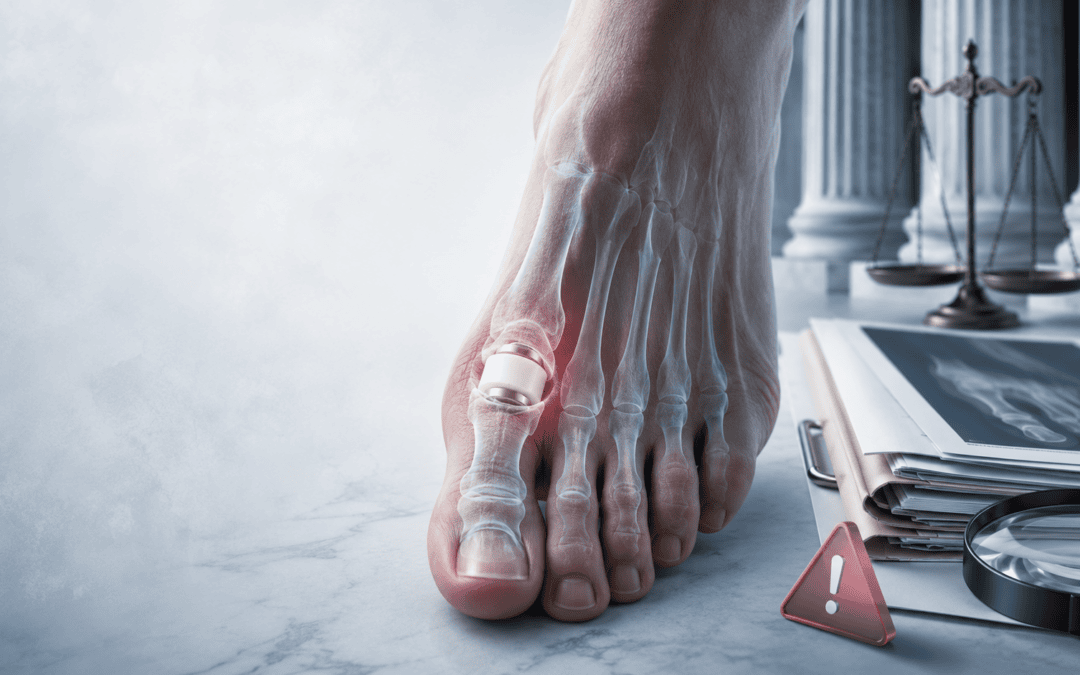
Federal lawsuits over the Cartiva Synthetic Cartilage Implant, a hydrogel device used to treat arthritis in the big toe, have been gathered into a single coordinated proceeding. As of the Judicial Panel on Multidistrict Litigation’s May 2026 docket report, MDL 3172 holds 16 pending cases. That is a small number, and the litigation is in its earliest stage. It is also growing, and it follows a nationwide recall of the device in 2024.
This post explains where the Cartiva litigation stands, why patients are filing claims, and what the federal proceeding means for New Yorkers who developed complications after a Cartiva implant.
Where the Cartiva Litigation Stands
On February 5, 2026, the Judicial Panel on Multidistrict Litigation centralized the federal Cartiva cases into MDL No. 3172, titled In re: Cartiva Synthetic Cartilage Implant Products Liability Litigation. The cases were transferred to the U.S. District Court for the Eastern District of Arkansas and assigned to Chief Judge Kristine G. Baker. The panel chose that district in part because of its proximity to Memphis, Tennessee, where Wright Medical Group, a predecessor company in the device’s corporate history, maintained its U.S. operations.
A multidistrict litigation, or MDL, is not a class action. Each plaintiff keeps an individual case. Consolidation simply moves the shared pretrial work, including discovery, expert issues, and early motions, in front of one judge. That avoids duplicated effort and conflicting rulings across the country. Any settlement or verdict still turns on the facts of each person’s injury.
The docket is new and modest in size. The panel’s May 2026 report lists 16 pending cases, up from 14 earlier in the spring. The court has not yet set a bellwether trial schedule or issued the kind of major pretrial rulings that shape larger mass torts. The litigation is organizing, not resolving.
The Device and the 2024 Recall
The Cartiva Synthetic Cartilage Implant, often called the Cartiva SCI, is a small cylindrical implant made of polyvinyl alcohol hydrogel. Surgeons place it in the first metatarsophalangeal joint, the joint at the base of the big toe, to treat a painful form of arthritis known as hallux rigidus. It was marketed as a motion-preserving alternative to fusion surgery, which relieves pain but permanently eliminates movement in the joint.
The device reached the U.S. market after the FDA approved it through the premarket approval pathway in 2016, the agency’s most demanding review process for medical devices.
In October 2024, Stryker, which became the device’s manufacturer after acquiring Wright Medical Group in 2020, initiated a Class II recall covering every lot of the device distributed from July 2016 through October 2024. The recall cited higher-than-expected rates of revision, removal, implant subsidence (the implant sinking into the bone), displacement, pain, nerve damage, and fragmentation. Because the recall reached every lot sold over an eight-year span, it pointed to the device itself rather than a single defective batch.
Why Patients Are Filing Claims
The original approval rested largely on a manufacturer-sponsored study comparing Cartiva to fusion, which reported that the implant performed about as well as fusion at two years. Independent research that followed was less favorable.
A 2022 reanalysis of that pivotal trial, published in Foot & Ankle International, found that under several reasonable alternative definitions of surgical success, the data no longer supported the conclusion that Cartiva was as good as fusion. Separately, a review of the FDA’s adverse-event database found implant subsidence to be the most frequently reported complication, alongside reports of fragmentation, infection, and the need for further surgery.
The lawsuits generally make two related claims: that the device was defectively designed, and that patients and their surgeons were not adequately warned about the real risk of failure. Many patients say they ultimately needed the same fusion surgery the implant was supposed to help them avoid.
The Central Legal Question
Because Cartiva was approved through the FDA’s premarket approval pathway, the manufacturer is expected to raise a federal preemption defense — the argument that a device’s federal approval limits certain claims brought under state law. That defense does not end these cases. Courts have long allowed patients to move forward where a manufacturer failed to meet the FDA’s own requirements, or where a device did not perform the way it was approved to perform.
That is where the recall and the adverse-event record matter. The manufacturer’s own 2024 recall acknowledged failure rates higher than the approved labeling reflected. For the people bringing these claims, that history is evidence that the device’s risks were greater than represented, and that the warnings patients received did not match how the device performed in the real world.
Who May Have a Claim
Generally, a person may have a claim if they received a Cartiva Synthetic Cartilage Implant and later experienced implant failure or complications that required treatment, particularly revision surgery or fusion. Common fact patterns include:
- Persistent pain or stiffness that did not improve, or grew worse, after the implant.
- Implant subsidence, displacement, or fragmentation confirmed on imaging.
- A revision surgery, meaning a follow-up operation to remove or replace the implant.
- Conversion to fusion (arthrodesis), which permanently fuses the big toe joint and is often the surgery the implant was meant to avoid.
- Bone loss, nerve damage, or chronic inflammation linked to the device.
Each case depends on its own facts. Helpful records include the surgical report identifying the implant and its size, imaging studies, and documentation of any later surgery. Because the device was sold for several years before the recall, some patients face the practical task of locating older medical and surgical records.
What This Means for New York Patients
New York patients injured by a Cartiva implant can pursue claims in the federal MDL, and New York product liability law shapes how those claims are evaluated. New York recognizes several theories in defective-product cases, including defective design and failure to warn. For a design claim, New York courts weigh whether a product’s risks outweighed its benefits and whether a safer, reasonable alternative was feasible. A failure-to-warn claim asks whether the manufacturer adequately disclosed risks it knew or should have known about.
For a device cleared through the FDA’s approval process, the federal preemption issue described above applies in New York as it does elsewhere. That is one reason these cases are best evaluated by an attorney familiar with both medical-device litigation and New York law. On Long Island and across the state, patients were treated at orthopedic and podiatric practices that used the device during the years it was on the market, and many are only now connecting ongoing toe problems to the recall.
Filing deadlines in injury cases are not one-size-fits-all. The deadline that applies to any particular claim depends on the specific facts and should be determined by an attorney rather than assumed. If you think you may have a claim, the safest step is to have it reviewed promptly.
What Comes Next
The next phase will be organizational. In a new MDL, the court typically appoints leadership for the plaintiffs, sets a schedule, and oversees the assembly of common evidence before any trials are scheduled. The federal preemption question is likely to be a central early battleground, and how the court handles it will influence the direction of the litigation. This is an active, fast-moving proceeding, and its posture can change; anyone following it should confirm the current status before relying on any single update.
For patients, the practical point is simple. The litigation is early, the evidence that will shape it is being developed now, and the value of any individual claim will depend on that record and on the specific facts of each case.
Speak With a New York Cartiva Implant Lawyer
If you or a loved one needed revision surgery, fusion, or other treatment after a Cartiva implant, the attorneys at the Law Offices of Rudolph F.X. Migliore, P.C. can evaluate your potential claim at no cost. We work with co-counsel networks active in MDL 3172 and can help you understand whether your case fits the federal litigation and what records will be needed to move forward.
Call our Commack office at 631-543-3663 for a free, confidential case evaluation, or use our online contact form. There is no fee unless we recover compensation for you.
This article is for general informational purposes and is not legal advice, and it reflects information available as of its publication date; laws, regulations, and case developments change over time. Each case depends on its specific facts, and any filing deadline that may apply should be determined by an attorney. Stryker denies wrongdoing, and no determination of liability has been made by any court. No outcome can be guaranteed in any litigation.