

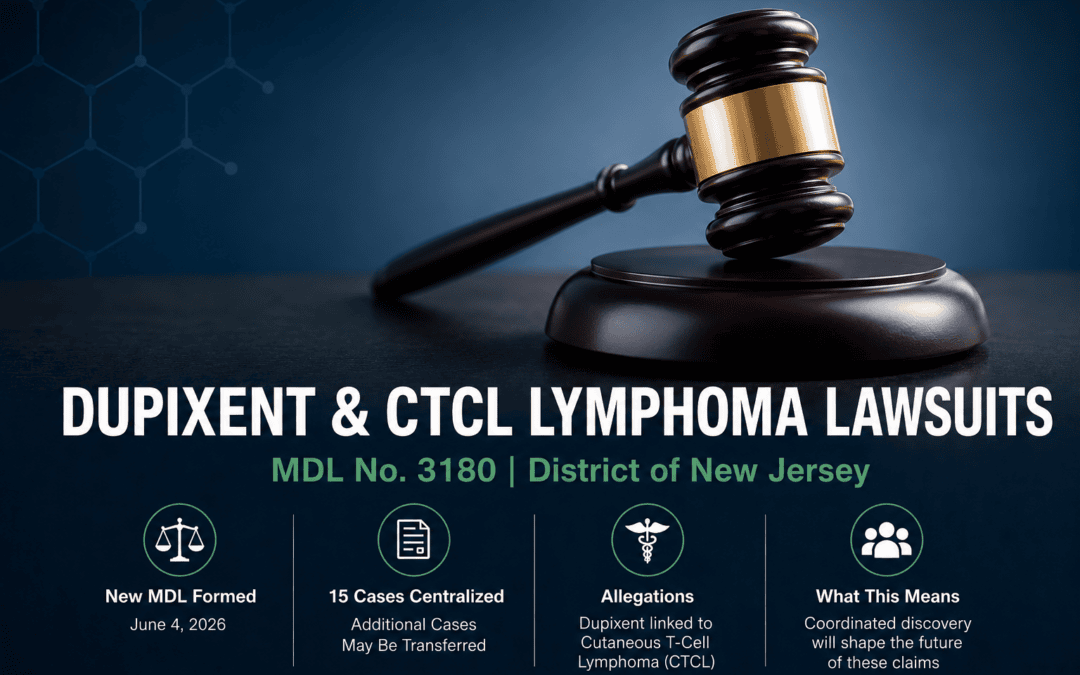
Federal lawsuits claiming that the eczema and asthma drug Dupixent caused users to develop a form of skin cancer have been gathered before a single judge. On June 4, 2026, the U.S. Judicial Panel on Multidistrict Litigation centralized the cases into a new multidistrict litigation, MDL No. 3180, in New Jersey. The proceeding is small and brand new, with just 15 cases at the outset, but it marks the moment scattered individual suits become a coordinated federal litigation.
If you took Dupixent and were later diagnosed with cutaneous T-cell lymphoma (CTCL), this is the litigation that will shape how these claims move forward. Because it is only beginning, the record built over the coming months — the scientific evidence, the discovery, the early rulings — will set the terms for every case that follows.
Where the Dupixent MDL Stands
A multidistrict litigation, or MDL, is a federal procedure that brings similar lawsuits from courts nationwide before one judge for coordinated pretrial handling. It is not a class action. Each plaintiff keeps a separate case, and consolidation mainly serves to make discovery and pretrial rulings more efficient.
The panel centralized 15 Dupixent lawsuits on June 4, 2026, creating MDL No. 3180, In re: Dupixent (Dupilumab) Products Liability Litigation, in the U.S. District Court for the District of New Jersey before Judge Zahid N. Quraishi. Several additional cases were identified as potential transfers. The two sides agreed that the cases should be consolidated but disagreed over where: plaintiffs asked for Georgia, and the manufacturers urged New York. The panel chose New Jersey for practical reasons. Sanofi’s principal place of business lies within the district, and Regeneron, though headquartered nearby in Tarrytown, New York, also maintains offices there. Much of the relevant testimony and evidence is therefore likely to be located in or around the district, which is also a convenient forum for a nationwide case.
For now, the MDL covers claims involving cutaneous T-cell lymphoma, the cancer at the center of the current cases. Every Dupixent lymphoma lawsuit consolidated so far involves that specific diagnosis rather than another form of the disease. The defendants are Regeneron Pharmaceuticals and Sanofi, which developed and market the drug.
Because the litigation is only weeks old, there is no trial date, no slate of test cases, and no ruling yet on the central scientific question. Those steps are still ahead.
What the FDA Has Said
Dupixent (dupilumab) is a biologic, a medicine made from living cells. The FDA approved it in 2017, and it is now prescribed for eczema, asthma, and several other conditions tied to a particular kind of immune-system inflammation. It is one of the best-selling drugs in the world.
In a quarterly FDA safety report covering October through December 2024, the agency identified cutaneous T-cell lymphoma as a potential safety signal associated with reports involving Dupixent, and stated that it is evaluating whether regulatory action is needed. That report is drawn from the FDA’s adverse event database, which collects reports of suspected side effects from patients and physicians.
It is worth being precise about what the listing means. The FDA stresses that this kind of entry is not a finding that a drug causes the harm. It flags a possible safety signal for further study, not a conclusion. The agency’s review remains open, and its status could change. The listing still matters to the litigation, because plaintiffs cite it as part of their argument that patients and doctors were not adequately warned.
The Science Behind the Claims
CTCL is a rare cancer of the T-cells, a type of white blood cell, that surfaces in the skin. Its two most common forms are mycosis fungoides and Sézary syndrome. Early on, it often appears as a persistent rash that can be hard to distinguish from eczema, which is part of what makes these cases medically complicated. The skin condition a patient takes Dupixent to treat and the lymphoma at the center of the lawsuits can resemble each other, and that overlap can delay an accurate diagnosis.
The lawsuits draw on a small but growing body of research. A 2024 cohort study in the Journal of the American Academy of Dermatology compared eczema patients who took dupilumab with eczema patients who did not, using a large national health-records database, and reported roughly a fourfold higher rate of CTCL in the dupilumab group (odds ratio 4.10). A separate analysis in the Journal of Allergy and Clinical Immunology found that CTCL was reported far more often for dupilumab than for other drugs and proposed a biological explanation for how the medication might allow the cancer to emerge or progress.
The evidence is contested, and honesty requires saying so. Several researchers have criticized the cohort studies, pointing out that severe eczema is itself associated with lymphoma and that early CTCL is easily mistaken for eczema, which can make a drug used to treat eczema look falsely linked to the cancer. One 2025 review in the American Journal of Clinical Dermatology called for vigilance rather than alarm, describing the signal as real but not established as a cause. A central question in the debate is whether Dupixent actually causes new cancer or instead reveals or accelerates lymphoma that was already present but undiagnosed. That is precisely the question the MDL will test.
Who May Have a Claim
In general terms, a person who took Dupixent and was later diagnosed with cutaneous T-cell lymphoma may be able to file a Dupixent cancer lawsuit. The lawsuits rest on a failure-to-warn theory: the allegation that the manufacturers knew or should have known of a lymphoma risk and did not adequately warn patients and prescribers. Sanofi and Regeneron deny that Dupixent causes CTCL, and no court has found them liable.
Each case turns on its own facts. The records that usually matter include proof of Dupixent use, the pathology confirming a CTCL diagnosis, and a medical timeline linking the two. Because CTCL is frequently mistaken for eczema at first, the date of an accurate diagnosis can come later than a patient expects, and piecing the sequence together from medical and pharmacy records is often part of the work.
The New York Connection
The Law Offices of Rudolph F.X. Migliore, P.C. represents New York residents, including clients across Long Island, in dangerous prescription drug litigation of this kind, working through co-counsel networks involved in the proceeding. New Yorkers are among the patients affected by these claims.
How any individual New Yorker’s case fits within MDL No. 3180, including which state’s law governs it, depends on the specific facts and is something the firm evaluates at intake. Anyone who believes they may have a claim should have it reviewed promptly, because time-sensitive deadlines can apply, and those deadlines vary from case to case.
What Comes Next
Because MDL No. 3180 is so new, the near-term steps are organizational: appointing the attorneys who will lead the plaintiffs’ side, entering case-management orders, and starting the exchange of documents and data. In time, the court will likely choose a handful of representative cases to prepare for early “bellwether” trials, which test how juries weigh the evidence. The results will not bind any individual Dupixent CTCL lawsuit, but they often influence later settlement talks. None of that has been scheduled.
Two developments are worth watching. The first is the FDA’s ongoing review of the CTCL signal, which could move in either direction. The second is how the court treats the scientific evidence, since the question of whether Dupixent causes CTCL, rather than simply appearing alongside it, sits at the heart of the litigation.
Speak With a New York Dupixent Lawyer
If you or a loved one was diagnosed with cutaneous T-cell lymphoma after using Dupixent, the attorneys at the Law Offices of Rudolph F.X. Migliore, P.C. can evaluate your potential claim at no cost. We work with co-counsel networks active in MDL No. 3180 and can help you understand whether your case fits the litigation and what records will be needed to move forward.
Call our Commack office at 631-543-3663 for a free, confidential case evaluation, or use our online contact form. There is no fee unless we recover compensation for you.
This article is for general informational purposes and is not legal advice, and it reflects information available as of its publication date; laws, regulations, and case developments change over time. Each case depends on its specific facts, and any filing deadline that may apply should be determined by an attorney. Sanofi and Regeneron deny wrongdoing, and no determination of liability has been made by any court. No outcome can be guaranteed in any litigation.