

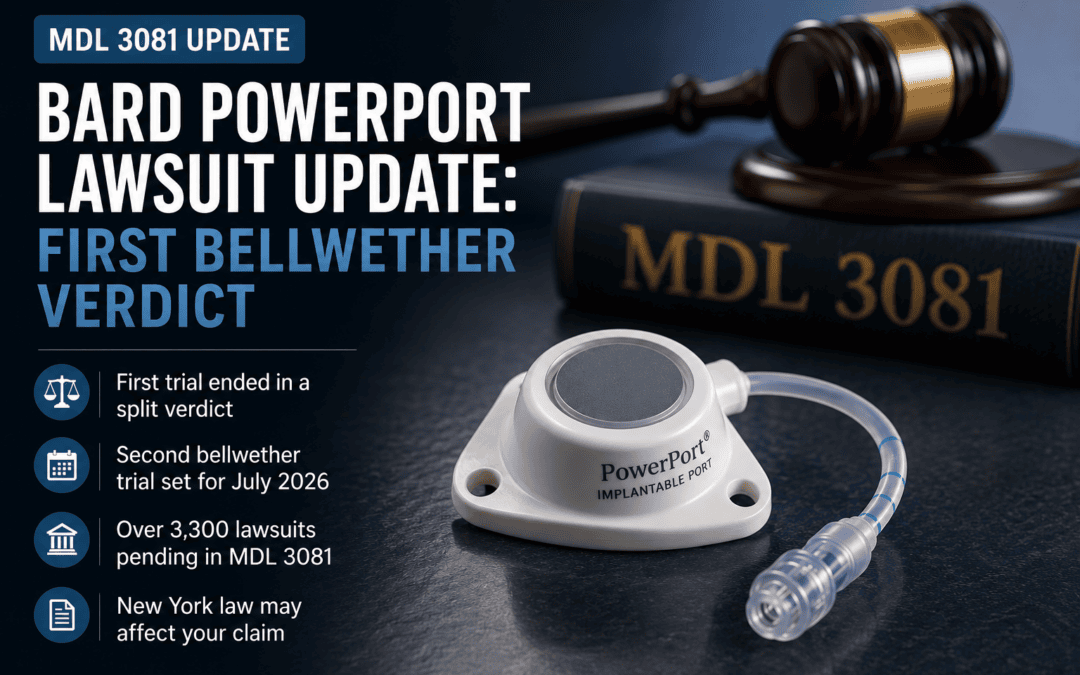
More than 3,300 lawsuits are now pending in the federal litigation over Bard’s PowerPort implanted catheters, and the first test case has already gone to a jury. According to the Judicial Panel on Multidistrict Litigation’s June 2026 docket report, MDL 3081 held 3,376 active cases as of June 1, 2026, with 3,583 filed to date. In May, the first of those cases produced a verdict. It was a split decision, and it left the central question in the litigation unresolved.
The Bard PowerPort is a chemotherapy port: a small device implanted under the skin, usually in the chest, that lets doctors deliver chemotherapy and other intravenous medications directly into a large vein. It is sometimes called a catheter, but in this case it used to provide long-term infusion access for cancer patients and others who need frequent IV treatment. The lawsuits focus on the device’s catheter tubing, which is made from a polyurethane that contains barium sulfate and which plaintiffs say can grow brittle, crack, and fracture inside the body. Plaintiffs allege those failures cause infections, blood clots, and the migration of catheter fragments, and that Bard knew of the risk but did not adequately warn patients or their doctors.
For patients who were injured after a PowerPort catheter fractured, migrated, or became infected, that outcome matters. Here is where the litigation stands, what the first trial actually decided, and how New York law applies to these claims.
Where the Bard PowerPort Litigation Stands
The federal cases are consolidated in the U.S. District Court for the District of Arizona before Senior U.S. District Judge David G. Campbell, who previously oversaw the Bard IVC filter litigation. A multidistrict litigation, or MDL, gathers similar lawsuits from across the country before one judge for coordinated pretrial proceedings. The cases are not merged into a single claim. Each plaintiff keeps an individual case, but discovery, expert rulings, and early trials are handled together.
Key Dates in MDL 3081
Several developments define the current phase of the litigation:
- May 2026: The first bellwether trial, Cook v. Becton, Dickinson and Company, produced a partial defense verdict on warning/instruction and related claims, while the jury deadlocked on design defect.
- June 2026: The Cook plaintiff moved for a new trial, challenging aspects of the jury instructions and verdict.
- August 2026: The next federal bellwether trial is expected to proceed after the previously scheduled July 2026 Miller case came off the trial calendar.
- Through early 2027: Additional bellwether trials remain scheduled, with different injury profiles intended to test the parties’ competing evidence.
Trial dates in active MDLs shift frequently, so these should be treated as current targets rather than fixed events.
What the First Bellwether Verdict Means
A bellwether trial is a test case. Its result does not bind any other plaintiff, but both sides watch closely because early verdicts shape how cases are valued and whether settlement talks gain momentum.
The Cook case involved a Minnesota patient who alleged his PowerPort became infected shortly after it was implanted for chemotherapy. At trial, his attorneys argued that Bard could have made the catheter safer years earlier, pointing to internal company records and to coatings and materials the company had studied but not adopted. Bard’s defense centered on regulatory compliance and on alternative explanations for the infection, including surgical factors and the patient’s own medical history.
The jury sided with the defense on the warning, instruction, and related claims. On the separate question of whether the catheter was defectively designed, the jurors could not reach agreement, leaving that count undecided. Because the design-defect issue was never resolved, it remains open. The plaintiff has since moved for a new trial, contending that the instructions given to the jury were flawed.
A defense result in the first test case is a setback for plaintiffs, but a single split verdict is a limited data point. Four additional federal bellwether trials remain after Cook, as currently scheduled, each built on a different injury profile.
A 510(k) Device and a Related FDA Recall
The PowerPort reached the market through the FDA’s 510(k) clearance process. That pathway lets a manufacturer sell a device by showing it is substantially equivalent to a product already on the market, without the same premarket approval showing of independent safety and effectiveness required for devices approved through the PMA pathway. The distinction carries legal weight, as explained further below.
The PowerPort has not been subject to a general FDA recall for the catheter-fracture, migration, infection, or barium-sulfate material-degradation theory at the center of MDL 3081. FDA records do show limited PowerPort-related recalls for different issues, including an incorrect tunneler-tip issue and a separate PowerPort duo recall involving flushing, infusion, aspiration difficulty, and septum dislodgement. Those recalls are separate from the catheter-degradation allegations being litigated in the MDL.
A separate Bard product has also drawn formal FDA attention. In 2025, the FDA reported a recall of Bard’s PowerPICC catheters after the company identified material fatigue that could cause the tubing to crack and leak, with ten serious injuries reported. The PowerPICC is a different device, a peripherally inserted central catheter rather than an implanted port, but the alleged failure mechanism, progressive cracking of the catheter material, echoes the core theory in the PowerPort cases.
The Allegations About the Catheter Material
The PowerPort catheter is made from a polyurethane compound that contains barium sulfate, a substance added so the device shows up on imaging. Plaintiffs allege that the barium sulfate is present at levels that make the material brittle over time, so that ordinary physiologic stress produces micro-cracks, surface pitting, and eventually fractures. Fragments can then break off and travel through the bloodstream toward the heart or lungs, and a weakened catheter can migrate from its intended position.
Plaintiffs further allege that these failures lead to infections, blood clots, and vascular injury, and that Bard had data pointing to the risk well before it adequately warned physicians. Bard disputes the design-defect theory and maintains that its devices met applicable standards and were cleared by the FDA. The competing expert testimony on this point, in particular whether the material degradation can be reliably connected to individual patients’ injuries, is what the bellwether trials are testing.
Who May Have a Claim
Generally, a person who was implanted with a Bard PowerPort or a related Bard port catheter and later suffered a serious complication may be able to bring a claim. The complications most often cited include:
- Catheter fracture or breakage
- Migration of the catheter or a fragment within the body
- Bloodstream infection or sepsis
- Blood clots or thrombosis
- Erosion of the device through the skin
- Surgery to remove or revise a failed device
Each case turns on its own facts. The key building blocks are documentation of the device, medical records establishing the injury, and a timeline connecting the two. Because port catheters are often implanted during cancer treatment and may fail years later, locating older records can be a practical hurdle. An attorney can help reconstruct that history through medical and pharmacy record requests.
What Comes Next
The unresolved design-defect question is the thread to watch. Because the Cook jury hung on that count, the issue heads back into the litigation rather than being settled, and the next several bellwether trials will give both sides a clearer read on how juries respond to the materials evidence. A string of plaintiff verdicts would increase pressure toward a broader resolution. Continued defense results would push valuations the other way.
This phase of MDL 3081 is moving quickly, and the trial schedule and post-trial rulings are evolving. Anyone weighing a potential claim should confirm the current status of the litigation rather than rely on a single snapshot.
Speak With a New York Bard PowerPort Lawyer
If you or a loved one suffered a serious injury after a Bard PowerPort or similar port catheter failed, the attorneys at the Law Offices of Rudolph F.X. Migliore, P.C. can evaluate your potential claim at no cost. We work with co-counsel networks active in MDL 3081 and can help you understand whether your case fits the federal litigation and what records will be needed to move forward.
Call our Commack office at 631-543-3663 for a free, confidential case evaluation, or use our online contact form. There is no fee unless we recover compensation for you.
This article is for general informational purposes and is not legal advice, and it reflects information available as of its publication date; laws, regulations, and case developments change over time. Each case depends on its specific facts, and any filing deadline that may apply should be determined by an attorney. Bard and Becton, Dickinson and Company deny wrongdoing, and no determination of liability has been made by any court. No outcome can be guaranteed in any litigation.