

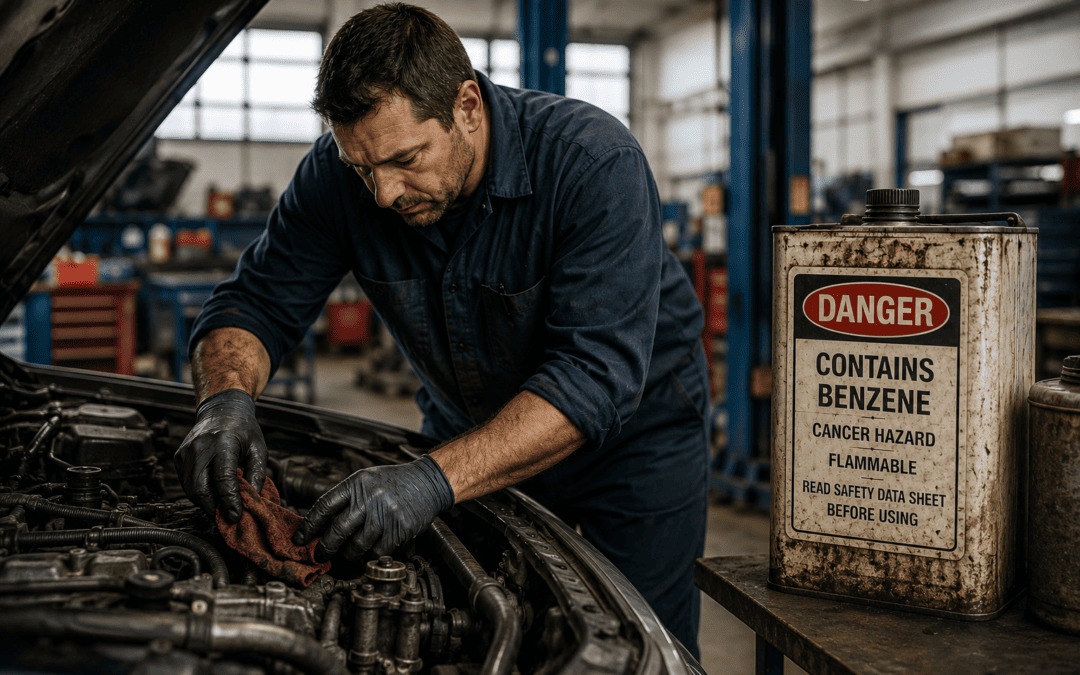
Benzene has been part of many Long Island workers’ occupational environments for decades. It was in the gasoline pumped at stations from Montauk to Great Neck. It was in parts-cleaning solvents, printing chemicals, and materials handled daily at fuel terminals and repair bays across Suffolk and Nassau counties. If you worked around gasoline or industrial solvents here and were later diagnosed with leukemia or another blood cancer, this article is for you. It explains where exposure happened, what the science says, and how benzene exposure lawsuits against the companies that made these products work.
What Benzene Is and Why It Matters
Benzene is a colorless, sweet-smelling liquid found naturally in crude oil, and it ranks among the most heavily produced chemicals in American industry. The National Cancer Institute states that benzene exposure increases the risk of leukemia and other blood disorders. According to the American Cancer Society, acute myeloid leukemia (AML) is the form of leukemia most strongly associated with benzene exposure. The International Agency for Research on Cancer and the National Toxicology Program both classify benzene as a known human carcinogen.
Federal regulators treat it accordingly. OSHA’s benzene standard caps workplace air at 1 part per million averaged over an eight-hour shift. In drinking water, the enforceable federal limit is 5 parts per billion; the health goal is zero.
Where Long Islanders Encountered Benzene
Occupational exposure drives most benzene litigation, and Long Island had plenty of it. Mechanics and service station workers handled gasoline every day, and many used it straight from the pump to clean greasy parts. Printers worked with solvent-based inks and press-cleaning chemicals. Painters, boatyard workers, fuel-terminal employees, and people in petroleum and chemical distribution encountered it for years, often without warnings or protective equipment.
Geography raises the stakes here. Nassau and Suffolk counties sit above a sole-source aquifer system that, according to the U.S. Geological Survey, supplies more than 400 million gallons of fresh water a day to over 2.8 million people through more than 1,500 public-supply wells. Whatever spills on Long Island has somewhere to go, and that somewhere sits beneath our drinking water.
The island has learned this the hard way. In the late 1980s, gasoline leaks were discovered at fuel terminals in East Setauket and Holtsville: roughly 1.2 million gallons at the first site and about 750,000 at the second. Those figures are recited in a New York Court of Appeals decision that grew out of the resulting insurance litigation. The gasoline reached the groundwater and spread beneath neighboring properties, and the legal fallout ran on for years. Environmental contamination and workplace exposure raise different legal claims, though. The largest recoveries have gone to workers with long, documented histories of direct contact, and that is where claims against manufacturers come in.
How Benzene Exposure Lawsuits Against Manufacturers Work
The core claim in most benzene injury cases is failure to warn, a product liability theory. The argument runs this way: the companies that made and sold benzene-containing products, from gasoline to solvents, degreasers, and thinners, understood the leukemia risk long before their labels said anything meaningful about it. Workers who developed blood cancers after years of routine contact were never told how to protect themselves. Plaintiffs may also allege defective design where safer formulations existed.
A Pennsylvania case illustrates the potential stakes of these claims. In May 2024, a Philadelphia jury awarded $725.5 million in compensatory damages to Paul Gill, a former mechanic who was diagnosed with acute myeloid leukemia after working with petroleum products at a service station in the late 1970s. Reuters reported that the jury found ExxonMobil liable for negligently failing to warn about benzene’s health risks. In September 2024, the trial court added more than $90 million in delay damages, bringing the judgment to approximately $816 million, according to Insurance Journal. ExxonMobil appealed, and the case remains pending before the Pennsylvania Superior Court. The verdict and judgment therefore should not be treated as a final determination of ExxonMobil’s liability.
Occupational benzene injury cases are not currently centralized in a single nationwide multidistrict litigation (MDL). Unlike some asbestos or pharmaceutical litigations, individual occupational cases generally proceed separately, making each claimant’s work history, product identification, exposure evidence, and medical causation particularly important.
Workers’ Compensation and Claims Against Manufacturers
New York workers diagnosed with an occupational disease generally have two separate paths. Workers’ compensation provides medical coverage and wage-replacement benefits without requiring proof of fault, but it is generally the exclusive remedy against the employer itself. A lawsuit against the manufacturers and suppliers of the benzene-containing products is a different action entirely. That third-party claim can seek the full range of civil damages, including pain and suffering, that the compensation system does not pay. The two systems interact, and a recovery in one can affect the other, so the claims are best handled in coordination.
A claim is not necessarily lost because the exposure ended decades ago. Blood cancers linked to benzene can develop years after the last day on the job. Which filing deadlines apply to any particular case depends on its specific facts and must be determined by an attorney.
Who May Have a Claim
Benzene cases are fact-intensive. A claim may be worth investigating if several of the following describe your situation:
- A diagnosis of acute myeloid leukemia or another leukemia or serious blood disorder
- Years of regular work around gasoline, solvents, degreasers, inks, or thinners, especially before modern warnings and protective practices
- Work as a mechanic, service station attendant, printer, painter, fuel-terminal or tank-farm worker, boatyard worker, or in chemical distribution or manufacturing
- The ability to identify worksites and, ideally, the products or suppliers involved
One candid note: cigarette smoke is itself a major benzene source. The National Cancer Institute reports that among smokers, 90 percent of benzene exposure comes from smoking, and defendants regularly point to smoking as an alternative cause. It complicates a case but does not automatically defeat one. Sorting out causation is work for qualified experts.
What to Do After a Diagnosis
Start with a written work history: employers, locations, years, job duties, and every product you can remember handling, down to brand names where possible. Gather employment records, union and pension records, and coworker names, and keep all medical records, including pathology reports. Then speak with an attorney promptly. Filing deadlines depend on case-specific facts, and only a lawyer who has reviewed your history can tell you where you stand.
Speak With a New York Benzene Exposure Lawyer
If you or a family member developed leukemia or another blood cancer after working around gasoline or industrial solvents on Long Island, the attorneys at the Law Offices of Rudolph F.X. Migliore, P.C. can evaluate your potential claim at no cost. We review the work history, the products involved, and the medical record to determine whether a potential third-party claim may exist. We work with a nationwide co-counsel network active in benzene and toxic-exposure litigation and can help you understand what records will be needed to move forward.
Call our Commack office at 631-543-3663 for a free, confidential case evaluation, or use our online contact form. There is no fee unless we recover compensation for you.
This article is for general informational purposes and is not legal advice, and it reflects information available as of its publication date; laws, regulations, and case developments change over time. Each case depends on its specific facts, and any filing deadline that may apply should be determined by an attorney. ExxonMobil denies wrongdoing, the verdict discussed remains on appeal, and no final determination of liability has been made. No outcome can be guaranteed in any litigation.