

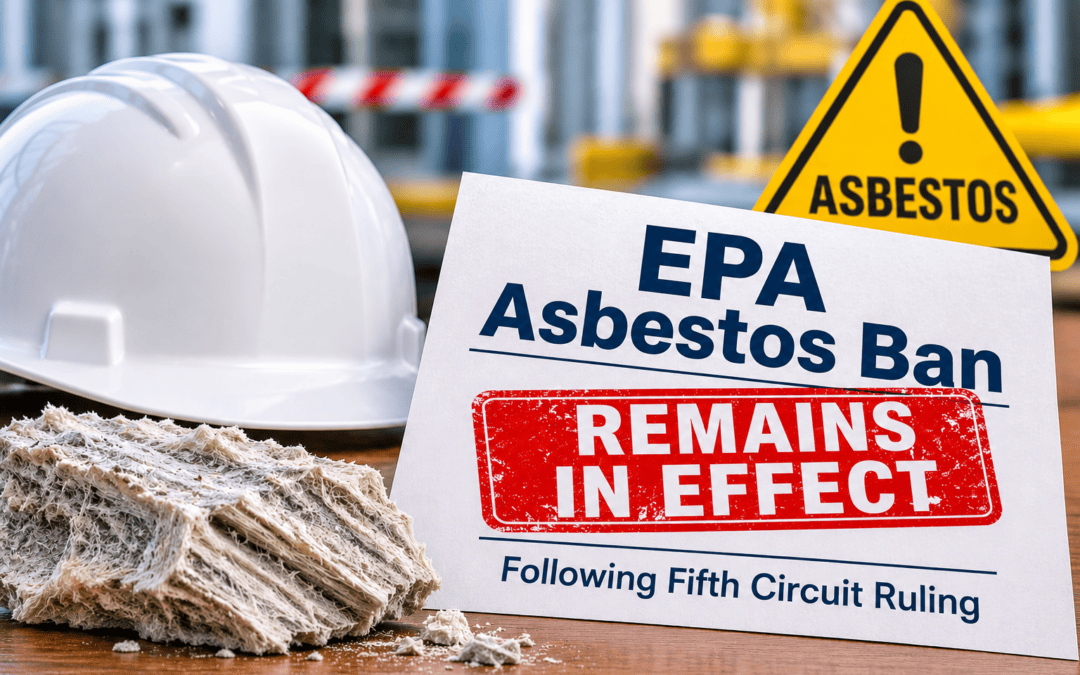
On November 19, 2026, a federal appeals court dismissed every pending challenge to the EPA asbestos ban. That is the 2024 rule prohibiting ongoing uses of chrysotile asbestos in brakes, gaskets, and chlorine manufacturing. The U.S. Court of Appeals for the Fifth Circuit held that none of the challengers had established standing to sue. It never decided whether the rule is lawful, and the rule remains in effect.
If you live or work in an older Long Island building, or spent years around brakes, gaskets, floor tile, or insulation, the ruling changes little. The rule covers asbestos products still being made, imported, or sold, not asbestos installed decades ago. There, New York’s own rules matter more.
The Fifth Circuit’s Decision on the EPA Asbestos Ban
Chrysotile is the only type of asbestos that EPA found was still being brought into the United States and put to use. The rule, published in the Federal Register and in effect since May 28, 2024, bans it in six kinds of products:
- Diaphragms used in the chlor-alkali industry, which makes chlorine
- Sheet gaskets used in chemical production
- Oilfield brake blocks
- Aftermarket automotive brakes and linings
- Other vehicle friction products
- Other gaskets
The bans on brakes, friction products, and other gaskets took hold after November 25, 2024. The sheet gasket ban followed after May 27, 2026, with some exceptions, and chlor-alkali plants have until 2029 or later to convert.
Chemical industry trade groups argued the rule went too far. The United Steelworkers, public health groups, firefighter union locals, and physicians argued it did not go far enough.
The court resolved none of it. Days before oral argument in June 2026, the judges raised standing, the requirement that a party show a concrete injury from the action it challenges. In the Fifth Circuit’s 15-page opinion, the panel found that the industry groups and the union had not supported their standing with evidence in their opening briefs. The health and firefighter groups had not shown a concrete injury that was actual or imminent. All of the pending petitions were dismissed.
Asbestos in Older Buildings and New York’s Code Rule 56
The 2024 rule does not address what EPA calls legacy uses: asbestos-containing materials no longer made or sold but still present in buildings. In a risk evaluation released in November 2024, EPA determined that asbestos presents an unreasonable risk to human health. It found that exposure from legacy uses is a significant contributor and pointed to several groups:
- Workers whose jobs involve cutting, sanding, or grinding asbestos-containing material, such as demolition crews
- Firefighters and other first responders
- Family members of exposed workers, through fibers carried home on clothing
- Do-it-yourself home renovators
- People living near demolition or renovation work
EPA cautioned that having asbestos-containing material in a home or school does not mean a person will become ill. Its concern is work that breaks the material apart and sends fibers into the air, not material left intact.
EPA has not yet proposed a rule for legacy asbestos. In June 2026, the agency said it would propose one by June 3, 2027. A lawsuit the Asbestos Disease Awareness Organization filed in April 2026 in federal court in Washington, D.C. contends that EPA missed a statutory deadline. It also calls the agency’s later extension to 2027 unlawful and asks a judge to set a schedule. EPA has told the court it will seek dismissal, and the court’s docket shows the case is still pending.
New York does not depend on that timetable. New York State Department of Labor guidance explains the state’s Industrial Code Rule 56. It generally requires an asbestos survey by a certified inspector before demolition, renovation, remodeling, or repair work. Material the work will disturb must first be removed by licensed contractors using certified workers. Limited exemptions exist, including one for owner-occupied single-family homes where the owner personally does the work. Even then, the Department recommends a licensed contractor.
How Asbestos Injury Claims Work in New York
Neither the EPA asbestos ban nor the Fifth Circuit’s ruling changes how a person harmed by asbestos seeks compensation. In New York, asbestos injury claims are generally brought under state law, usually against companies that made or supplied asbestos-containing products. Contractors or property owners may also be responsible, depending on the facts.
These cases often turn on proof of exposure. New York’s highest court, the Court of Appeals, addressed that proof in Nemeth v. Brenntag North America (2022), a mesothelioma case over talcum powder alleged to contain asbestos. A plaintiff needs expert evidence of exposure to enough of the substance to cause the disease. An exact measurement is not always required, but the expert’s methods must be generally accepted. The court found the proof in Nemeth insufficient and dismissed the claim against the talc supplier.
In a decision filed in October 2026, a Manhattan trial judge upheld a mesothelioma verdict for a former flooring laborer. He had installed and removed asbestos floor tile, a legacy product, in the 1970s and 1980s. The manufacturer has appealed. Our summary of the floor tile verdict covers the evidence.
Claims by family members face a limit. In a 2005 Court of Appeals decision, an employee’s wife alleged she was exposed while laundering his work clothes. The court held that his employer, which also owned the work sites, owed her no duty of care. It did not decide whether manufacturers owe such a duty. Whether a household member has a claim depends on who is being sued and on the facts.
Filing deadlines apply to all of these claims. The deadline in a particular case depends on its facts and must be determined by an attorney, so speak with a lawyer promptly.
Exposure Histories Worth Reviewing
Not every exposure leads to illness or supports a claim. These histories may be worth discussing with a lawyer:
- Construction, demolition, renovation, or maintenance work that involved cutting, sanding, or tearing out older floor tile, pipe insulation, plaster, or roofing (see our guide to asbestos claims in the construction trades).
- Years of brake, clutch, or gasket work in a repair shop or industrial plant.
- Service as a firefighter in older buildings.
- Renovation or demolition done around you without an asbestos survey, or by crews without asbestos training.
- A diagnosis of mesothelioma, lung cancer, or asbestosis following any of these.
What Comes Next
The challengers may ask the Fifth Circuit to rehear the case or seek further review. EPA’s work on a legacy asbestos rule and the Washington lawsuit are both still moving, so confirm their current status before relying on this summary.
Speak With a New York Asbestos Lawyer
We review mesothelioma, lung cancer, and asbestosis claims tied to asbestos in building materials, brakes, gaskets, and other products. The attorneys at the Law Offices of Rudolph F.X. Migliore, P.C. can evaluate your potential claim at no cost. We work with co-counsel networks active in asbestos litigation and can help you understand whether you may have a claim and what records will be needed to move forward.
Call our Commack office at 631-543-3663 for a free, confidential case evaluation, or use our online contact form. There is no fee unless we recover compensation for you.
This article is for general informational purposes and is not legal advice, and it reflects information available as of its publication date; laws, regulations, and case developments change over time. Each case depends on its specific facts, and any filing deadline that may apply should be determined by an attorney. No outcome can be guaranteed in any litigation.