

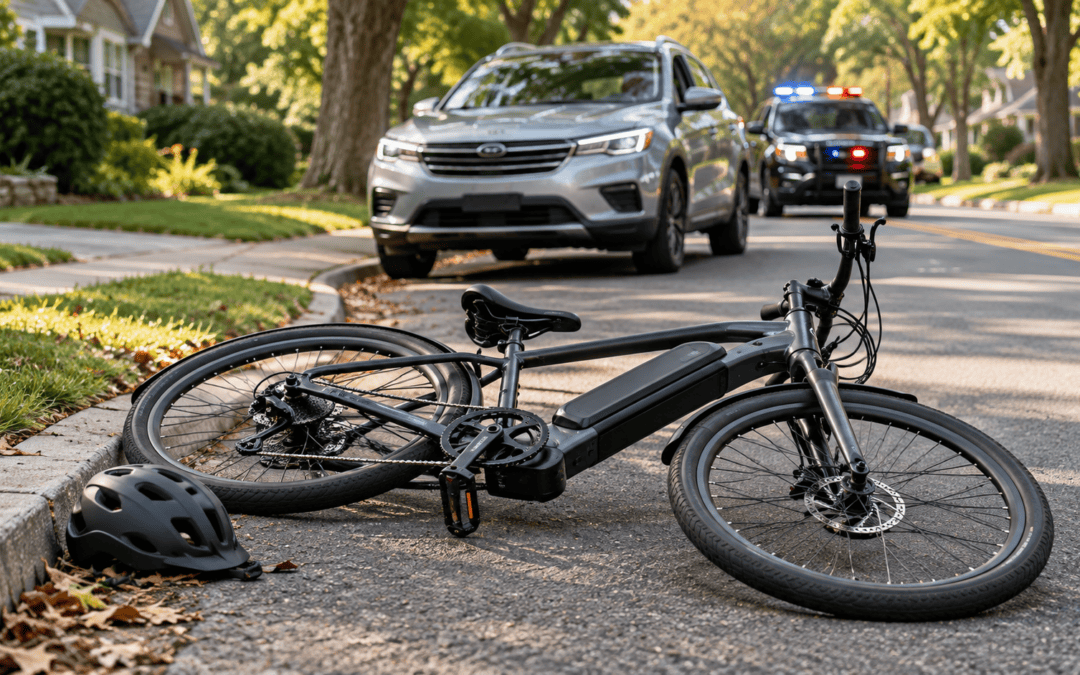
On September 17, a trauma surgeon at Northwell’s South Shore University Hospital called the wave of e-bike injuries on Long Island “a real public safety and public health crisis.” Area hospitals are seeing at least 40 patients a year hurt in e-bike, e-scooter, and motorized dirt bike crashes, ABC7 reported, and some of the life-threatening injuries have been to children as young as 8. Suffolk County police told the station they have seized more than 200 vehicles determined to be illegal.
If you or your child was hit by a car while riding an e-bike in Suffolk or Nassau County, start here. The driver’s insurance is usually the first source for your medical bills, whatever the county rules say about your riding. This post explains how that works, how the new county rules shape the claim, and how the 2026 comparative-fault changes raise the stakes on the rider’s own conduct.
What Suffolk and Nassau Now Require of E-Bike Riders
Suffolk County Local Law No. 6-2026 took effect in January, and police began full enforcement on March 1, 2026, after a two-month education period, according to Greater Long Island. State law already bars riders under 16, limits e-bikes to roads posted at 30 mph or less, and prohibits sidewalk riding unless a local law allows it. Suffolk adds a helmet requirement for every rider and a ban on riding any sidewalk in the county. Reckless riding brings impoundment, and a bike ridden by anyone under 16 is subject to seizure. Fines start at up to $500 and escalate to misdemeanor-level penalties and impoundment for repeat offenses within five years, and parents are responsible for a minor’s fines.
Nassau County took a different route. On March 5, county police announced they would enforce a ban on Class 2 and Class 3 e-bikes and e-scooters on county roads and property. The law they cited predates New York’s 2020 e-bike framework and names motorized scooters, off-highway motorcycles, and pocket bikes, not e-bikes. An attorney quoted by the New York Post said the county is citing a section of law that does not apply. In April a county legislator introduced a bill to align Nassau’s rules with state law, Streetsblog reported. As of this writing the bill had not advanced, and enforcement may change, so confirm the current status before relying on it. Last November, a 14-year-old riding his e-bike to school in North Bellmore died after an SUV collided with him. CBS New York reported that police could not say who had the light.
Why a Crash With a Car Is Still a Car Accident Case
A legal e-bike carries no registration or insurance, according to the New York DMV, so many injured riders assume they are on their own. Under New York’s no-fault system, they usually are not. The Vehicle and Traffic Law excludes bicycles with electric assist from its definition of a motor vehicle. That puts an e-bike rider in the same position as a bicyclist or a pedestrian. When a car strikes that rider, the Insurance Law requires the car’s insurer to pay first-party benefits to persons other than occupants of another motor vehicle or a motorcycle. First-party benefits means medical bills and a share of lost wages, paid regardless of who caused the crash.
The lawsuit against the driver is separate, and it carries the same “serious injury” threshold as every New York car case. The threshold is a list of injury categories that a plaintiff must establish before recovering for pain and suffering. A fracture qualifies; so does a permanent consequential limitation of a body part. As we explained in our post on the 2026 auto insurance reform, the 90/180-day category is gone for actions commenced on or after May 26, 2026, according to the Department of Financial Services. Soft-tissue injuries in those cases must be proven through the remaining categories, with objective medical evidence.
Two situations call for extra care. If the driver fled or was uninsured, compensation may still be available through the rider’s household auto policy. New York residents with no other coverage may turn to the Motor Vehicle Accident Indemnification Corporation, or MVAIC. Both routes carry strict notice requirements. The second situation is the device itself. Outside New York City, a throttle machine without working pedals, a motor of 750 watts or more, or assistance beyond 20 mph is not a legal e-bike. It may be treated as an unregistered motorcycle, which can cost the rider no-fault benefits and change the rules that govern the claim. Classifying the device is one of the first things we do at intake.
The 2026 Comparative-Fault Bar Puts the Rider’s Conduct on Trial
For decades, a New York plaintiff who shared fault simply had the award reduced by that share. That changed for actions commenced on or after May 26, 2026. In personal injury actions subject to the no-fault law, the CPLR now bars recovery entirely if the claimant’s culpable conduct is greater than the defendant’s. With several defendants, the comparison is to their combined culpable conduct. A rider found 51 percent at fault recovers nothing from the driver. The trier of fact, usually a jury, must now decide fault before it decides whether the injury was serious. The bar applies to the lawsuit, not to no-fault benefits, which are paid regardless of fault.
That turns the county rules into more than a ticketing matter. Expect the driver’s insurer to argue that the rider came off a sidewalk into a crosswalk, was riding against traffic, or was on a road posted at 40 mph. Each violation is evidence the defense will use to push the rider’s share of fault past the halfway line. The driver’s conduct matters just as much: speed, phone use, a left turn across the rider’s path, a right on red without looking. One argument the statute takes away is age. State law provides that a rider’s violation of the under-16 rule “shall not constitute contributory negligence or assumption of risk” and cannot reduce the damages recoverable. A child’s age cannot be held against the child. How the child actually rode still can. Suffolk’s own age rule is a separate county provision, and we have found no decision addressing it, though we would expect the state protection to control.
Helmets are a different kind of issue. The state helmet statute provides that failing to comply with it “shall not constitute contributory negligence or assumption of risk” and shall not “diminish or reduce the damages recoverable.” But the state statute requires helmets only for class 3 riders and young children, so an adult on a class 1 or 2 e-bike who breaks Suffolk’s broader mandate may fall outside that protection. For riders outside it, a 2016 Appellate Division decision, Matter of Corwin v City of New York, treats a bicyclist’s failure to wear a helmet as a question of damages, not fault. It cannot raise the rider’s share of liability, and the defendant must prove that a helmet would have prevented some or all of the injuries. How the Second Department, which hears Long Island appeals, will treat Suffolk’s mandate is untested.
Examples of Issues That Can Arise
- A rider on a road posted above 30 mph sideswiped by a driver who never saw the bike, with the speed limit itself becoming the defense’s main argument.
- A hit-and-run in a shopping center lot, where the only witness is a store camera that overwrites its footage within days.
- A child under 16 on a throttle bike bought online, which police classify as an unregistered motorcycle after the crash.
What to Do After an E-Bike Crash
- Get medical care the same day and tell the provider a car hit you while you were riding an e-bike.
- Call the police, get the report number, and photograph the bike, its class and wattage label, the road, the posted speed limit, and the vehicle that hit you.
- Keep the e-bike as it is. Do not repair or discard it, because its classification may be contested.
- Consult an attorney promptly. No-fault, uninsured-motorist, and MVAIC claims carry notice requirements, and any deadline that applies to a lawsuit should be determined by an attorney.
Speak With a New York E-Bike Accident Lawyer
If you or your child was hurt in a collision between an e-bike and a motor vehicle on Long Island, the attorneys at the Law Offices of Rudolph F.X. Migliore, P.C. can evaluate your potential claim at no cost. The firm represents injured people throughout Nassau and Suffolk counties in car, truck, and motorcycle accident claims. We can help you understand what records, reports, and evidence your case will need.
Call our Commack office at 631-543-3663 for a free, confidential case evaluation, or use our online contact form. There is no fee unless we recover compensation for you.
This article is for general informational purposes and is not legal advice, and it reflects information available as of its publication date; laws, regulations, and case developments change over time. Each case depends on its specific facts, and any filing deadline that may apply should be determined by an attorney. No outcome can be guaranteed in any litigation.