

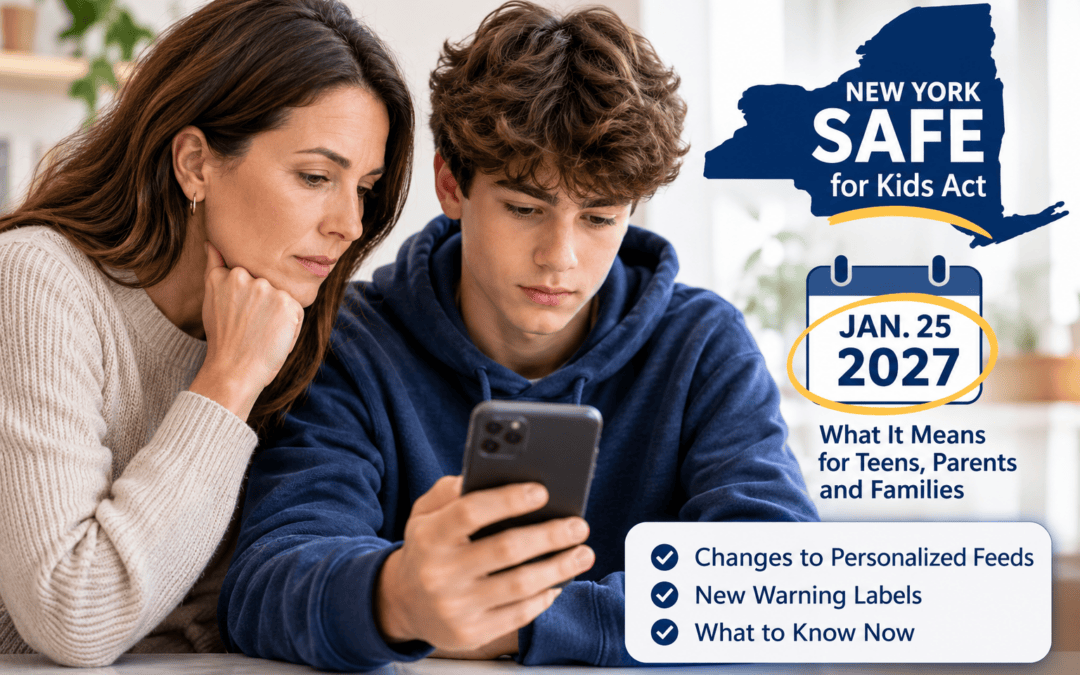
On January 25, 2027, New York’s Stop Addictive Feeds Exploitation (SAFE) for Kids Act takes effect. On covered apps, users under 18 will lose feeds that an algorithm builds around their behavior unless the teen and a parent both agree. Without a parent’s consent, overnight notifications about those feeds will stop too.
If you are raising a teenager on Long Island, the apps on your child’s phone are about to change. The law looks forward, though. It does not compensate families for harm a child has already suffered.
The Changes Starting January 25
The law, signed in June 2024, reaches platforms where a personalized feed is a significant part of the service. The Attorney General’s office announced final rules on July 28, 2026, and their publication the next day started the 180-day countdown to January 25. The final rule text generally covers a platform when personalized feeds take up at least 20 percent of the time its monthly active users spend there. The rules exempt platforms below certain user-count thresholds unless minors are their main users.
The statute calls these “addictive feeds”: feeds that use information about a user, or the user’s device, to pick and rank what appears next. Teens can still get posts from accounts they follow, or a feed sorted by time. For New York users:
- Users under 18 get a personalized feed only if the teen agrees to let the platform ask a parent and the parent gives verifiable consent. Platforms need not offer this. If they do, the parent must pass an age check, and either one can withdraw consent at any time.
- Without a parent’s consent, platforms may not send users under 18 notifications about the feed between midnight and 6 a.m. Eastern. The feed and these notifications each require their own consent, even when both are requested together.
- Adults will be asked to complete an age check before getting a personalized feed. At least one option must work without a government ID. Platforms must delete data from the check once it is no longer needed but keep limited records, such as the result, for at least five years.
- A notice asking a parent for consent may not reveal what the teen does on the app.
- Saying no does not cost a teen access. Platforms may not cut off or degrade service because they cannot provide the personalized feed.
Who Enforces the Law
The Act puts enforcement in the hands of the New York Attorney General. Under General Business Law § 1508, the Attorney General may ask a court to stop violations. The office may also seek restitution, damages, the surrender of profits, and civil penalties of up to $5,000 per violation. No enforcement case may begin until 180 days after the law takes effect. The statute does not expressly give families a right to sue under it.
Injury Claims Proceed Separately
The law governs how platforms operate from 2027 on. It does not decide whether any platform’s design injured a child. Those questions belong to injury lawsuits already pending around the country. Federal cases are gathered before one judge for pretrial proceedings in MDL 3047, a multidistrict litigation in the Northern District of California. It had 4,309 actions pending as of November 2, 2026, according to the Judicial Panel on Multidistrict Litigation. Other cases are coordinated in Los Angeles Superior Court in a proceeding known as JCCP 5255, PBS NewsHour has reported. An MDL is not a class action, and coordinating cases does not establish that any company is liable. Our overview of social media addiction lawsuits explains these claims.
The Law Offices of Rudolph F.X. Migliore, P.C. represents New York residents, including Long Island families, in those national proceedings through its local and nationwide co-counsel network. Which state’s law governs a particular claim is a fact-specific question we evaluate at intake.
Meta’s August 2026 settlement with state attorneys general, including New York’s, runs on its own track. A federal judge entered it as a consent judgment, a court order both sides agreed to, on August 26. For teens in the settling states, it sets default limits on Instagram and Facebook. The defaults cap combined use at two hours a day and block use from midnight to 6 a.m., with exceptions such as messaging. Loosening them requires a parent’s approval. Meta must have these defaults in place within six months after the settlement takes effect. As our post on the settlement explains, it does not resolve or pay any personal injury claim.
Warning Labels Start January 1
New York’s social media warning-label law, General Business Law Article 45-A, takes effect a few weeks earlier, on January 1, 2027. It covers platforms where personalized feeds, autoplay, or infinite scroll are a significant part of the service. On any day a platform offers one of those features, a New York user’s first visit triggers a mental health warning written into the statute. It must stay on screen for at least 10 seconds and cover at least a quarter of the screen. After three hours of cumulative active use that day, it returns for at least 30 seconds, covering at least three-quarters of the screen. It repeats after each additional hour of active use. Users cannot click past it. Platforms do not have to show it to users they reasonably determine are adults. The Attorney General enforces this law too, with penalties of up to $5,000 per violation.
One provision matters for injury claims. The law says that showing the warning does not waive or limit other legal claims, apart from claims under the label law itself. It is also no defense to a failure-to-warn claim, which alleges that a company did not adequately disclose a known risk of its product. The provision preserves those claims; it does not prove them.
What Parents Can Do Now
- Talk with your teen before January about the age checks and consent requests that are coming.
- When a platform asks you to confirm an age, look for the option that shares the least personal information.
- To report a platform you believe is not following the law, use the Attorney General’s online complaint form, which has a category for technology issues.
- If your child was diagnosed with depression, anxiety, an eating disorder, or another serious condition after heavy social media use, your child’s treatment and safety come first. Keep the treatment records. If an account will be deleted or deactivated, try to download its data first. Speak with an attorney promptly, because deadlines may apply and depend on the facts of each case.
What Comes Next
NetChoice, a technology industry group, called the final rules unconstitutional the day after their release. As of November 3, 2026, we are not aware of a lawsuit challenging either New York law. The group has challenged label laws elsewhere: a federal court paused Colorado’s, and NetChoice sued Minnesota over its version in April 2026, MPR News reported. A court challenge could delay or change either New York law, so check their current status before relying on the dates in this article.
Speak With a New York Social Media Addiction Lawyer
If your child developed a serious mental health condition after heavy social media use, we can review the history and the records with you. The attorneys at the Law Offices of Rudolph F.X. Migliore, P.C. can evaluate your potential claim at no cost. We work with co-counsel networks active in the social media addiction litigation and can help you understand whether your case fits the litigation and what records will be needed to move forward.
Call our Commack office at 631-543-3663 for a free, confidential case evaluation, or use our online contact form. There is no fee unless we recover compensation for you.
This article is for general informational purposes and is not legal advice, and it reflects information available as of its publication date; laws, regulations, and case developments change over time. Each case depends on its specific facts, and any filing deadline that may apply should be determined by an attorney. This article does not evaluate whether any particular platform complies with New York law. Meta denies wrongdoing, and its settlement contains no admission of liability. No outcome can be guaranteed in any litigation.