

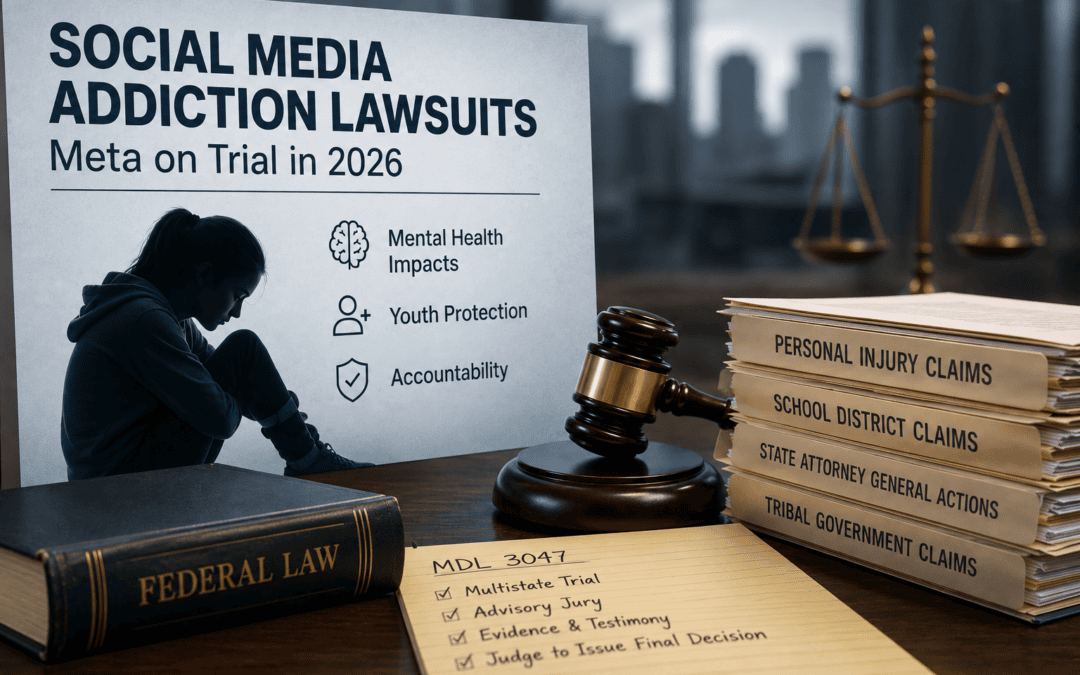
Opening statements began on August 18, 2026, in a federal courtroom in Oakland, California, in the biggest trial yet over whether social media platforms were built to hook children. Four state attorneys general, representing California, Colorado, Kentucky, and New Jersey, are presenting claims that Meta engineered Instagram and Facebook to capture and hold the attention of minors. The states also say Meta deceived the public about how safe its platforms are for young users. The docket in the consolidated federal proceeding, MDL 3047, records that the jury trial began August 18 before U.S. District Judge Yvonne Gonzalez Rogers.
If your child or teenager developed serious mental health problems after prolonged use of Instagram, TikTok, Snapchat, or YouTube, the allegations being litigated in these cases may be relevant to your circumstances. The social media addiction lawsuits now involve thousands of families, school districts, and state attorneys general across the country. The next several months, including a decision expected this fall, will shape how the remaining cases move.
Where the Litigation Stands
The federal cases are consolidated in multidistrict litigation, or MDL, a procedure that gathers related lawsuits from around the country before a single judge for coordinated pretrial work. MDL 3047, formally titled In re: Social Media Adolescent Addiction/Personal Injury Products Liability Litigation, sits in the Northern District of California before Judge Yvonne Gonzalez Rogers. As of the Judicial Panel on Multidistrict Litigation’s August 3, 2026 report, 3,137 actions were pending in the MDL.
The litigation includes several major plaintiff groups: individual and family personal injury claims, school district and other public entity claims, state enforcement actions, and claims by tribal governments. A separate coordinated proceeding in California state court in Los Angeles involves roughly 2,500 additional personal injury plaintiffs. The defendants are Meta (the parent of Facebook and Instagram), Snap, TikTok and its parent ByteDance, and Google and YouTube. Every defendant denies the allegations. For background, see our social media addiction lawsuits overview.
Key Milestones in 2026 So Far
- Late January: TikTok and Snap reached undisclosed settlements with the plaintiff in the first Los Angeles personal injury trial, leaving Meta and Google to defend the case alone.
- March 25: The Los Angeles jury found Meta and YouTube liable to plaintiff K.G.M., a 20-year-old Californian. The award was $6 million, split between $3 million compensatory and $3 million punitive, with 70 percent of the responsibility allocated to Meta and 30 percent to Google. Both companies said they would challenge the result.
- May 20: The first federal school district bellwether, brought by Breathitt County School District in Kentucky, settled shortly before its scheduled June trial, and the court entered a dismissal with prejudice. Settlement records reported by Kentucky’s WKYT show a combined $27 million: $9 million from Meta, $8 million each from TikTok and Snap, and $2 million from YouTube.
- July 22: The second Los Angeles trial plaintiff, a 15-year-old identified as R.K.C., dropped his remaining claims against Meta days before trial. He had reached confidential settlements with Google, TikTok, and Snap.
- August 10: In State of Colorado v. Meta Platforms, Inc., the Ninth Circuit held that Section 230, the federal law that limits platforms’ liability for content users post, is a defense to liability rather than immunity from being sued, and dismissed Meta’s and TikTok’s appeals as premature. The court also declined Meta’s request to delay the multistate trial, Axios reported.
- August 18: The multistate trial against Meta opened in Oakland before Judge Gonzalez Rogers.
Inside the Multistate Trial Against Meta
Twenty-nine states are participating in the attorney general track, according to Tech Policy Press, with four of them presenting claims at this trial. The states allege that Meta violated their consumer protection laws by building features such as infinite scroll, push notifications, and engagement-driven algorithms to keep minors on Instagram and Facebook. They also allege violations of the Children’s Online Privacy Protection Act, the federal statute known as COPPA, through the collection of data from children under 13 without parental consent.
The trial’s structure is unusual. An eight-person jury is hearing the evidence in an advisory role, while Judge Gonzalez Rogers will issue the final ruling. The trial is expected to run six to eight weeks. Beyond monetary relief, the states are asking the court to order design changes, including age restrictions and limits on the features and algorithms directed at minors.
Meta disputes the allegations, points to the youth safety tools it has adopted, and argues that the states cannot prove its platforms caused the harms they describe. Meta has characterized the states’ potential penalties, which the company says could reach roughly $1.4 trillion, as wildly out of proportion. Mark Zuckerberg and Instagram head Adam Mosseri are expected to testify, according to Claims Journal.
What the First Results Signal
A bellwether is a test case, tried early so both sides can see how juries react to the evidence. The outcome does not bind other cases, but it often shapes settlement talks. Read together, this year’s results show three things. Juries can be persuaded: the K.G.M. verdict was the first jury verdict in the California coordinated personal injury litigation, and it treated platform design as a legal cause of a young user’s mental health harms. The platforms will pay to resolve some claims rather than try them: TikTok, Snap, and Google have each settled individual claims confidentially, and the companies paid a combined $27 million to resolve the first federal school district bellwether. And the litigation is moving: the Ninth Circuit’s August 10 decision means Section 230 cannot stop these cases before trial, though the defense remains available as the cases proceed.
None of this guarantees anything for pending or future claims. The K.G.M. verdict is being challenged. The advisory jury structure means the multistate case will ultimately be decided by the judge. There is no global settlement, and the defendants continue to deny that their products cause the harms alleged. On the science, researchers continue to debate causal relationships, mechanisms, and the magnitude of the risks, even as studies document associations between social media use and adolescent mental health outcomes. The companies press that debate in every case.
Who May Have a Claim
Claims in the personal injury litigation commonly allege facts such as:
- Heavy use of Instagram, TikTok, Snapchat, or YouTube that began while the user was a minor;
- A diagnosed condition such as depression, anxiety, an eating disorder, or self-harm, supported by treatment records;
- A history that places the onset or worsening of the condition during or after the period of heavy use, which can bear on the evidence of causation.
These are common features of the filed cases, not a legal test, and alleging them does not mean a case will succeed. Whether any individual claim is viable, and where it belongs, is a case-specific legal judgment that requires review by an attorney.
The Litigation’s New York Footprint
New York joined the federal action against Meta at the outset. Attorney General Letitia James’s office announced on October 24, 2023 that New York had signed onto the multistate federal complaint over Instagram and Facebook design features. Closer to home, Long Island school districts, including South Huntington and Jericho, have filed their own suits against the platforms. The districts point to the cost of responding to the youth mental health crisis in their schools.
The Law Offices of Rudolph F.X. Migliore, P.C. represents New York residents, including Long Island families, in these national proceedings through its local and nationwide co-counsel network. Consolidated pretrial proceedings run under federal procedure and the MDL court’s orders, and which state’s law applies to any individual case is a fact-specific question evaluated at intake. For platform-specific background, see our Instagram lawsuit page.
What Comes Next
The multistate trial is expected to conclude in the fall, with Judge Gonzalez Rogers’s decision to follow. In the Los Angeles coordinated proceeding, the next personal injury trial is scheduled for October 2026. On the federal side, Case Management Order No. 35 sets the next school district bellwethers. Jury selection begins February 3, 2027, in Tucson Unified School District v. Meta Platforms Inc.; Charleston County School District v. Meta Platforms Inc. follows. This is a fast-moving docket, and the status of any trial date, ruling, or settlement described here should be confirmed as of the day you read it.
Speak With a New York Social Media Addiction Lawyer
We evaluate whether a young person’s mental health harms and platform history fit the criteria emerging from these consolidated proceedings. The attorneys at the Law Offices of Rudolph F.X. Migliore, P.C. can evaluate your potential claim at no cost. We work with co-counsel networks active in the social media addiction litigation and can help you understand whether your case fits the litigation and what records will be needed to move forward.
Call our Commack office at 631-543-3663 for a free, confidential case evaluation, or use our online contact form. There is no fee unless we recover compensation for you.
This article is for general informational purposes and is not legal advice, and it reflects information available as of its publication date; laws, regulations, and case developments change over time. Each case depends on its specific facts, and any filing deadline that may apply should be determined by an attorney. Meta, Snap, TikTok, and Google deny wrongdoing; the verdict described in this article is being challenged and is not a determination of liability in any other case. No outcome can be guaranteed in any litigation.