

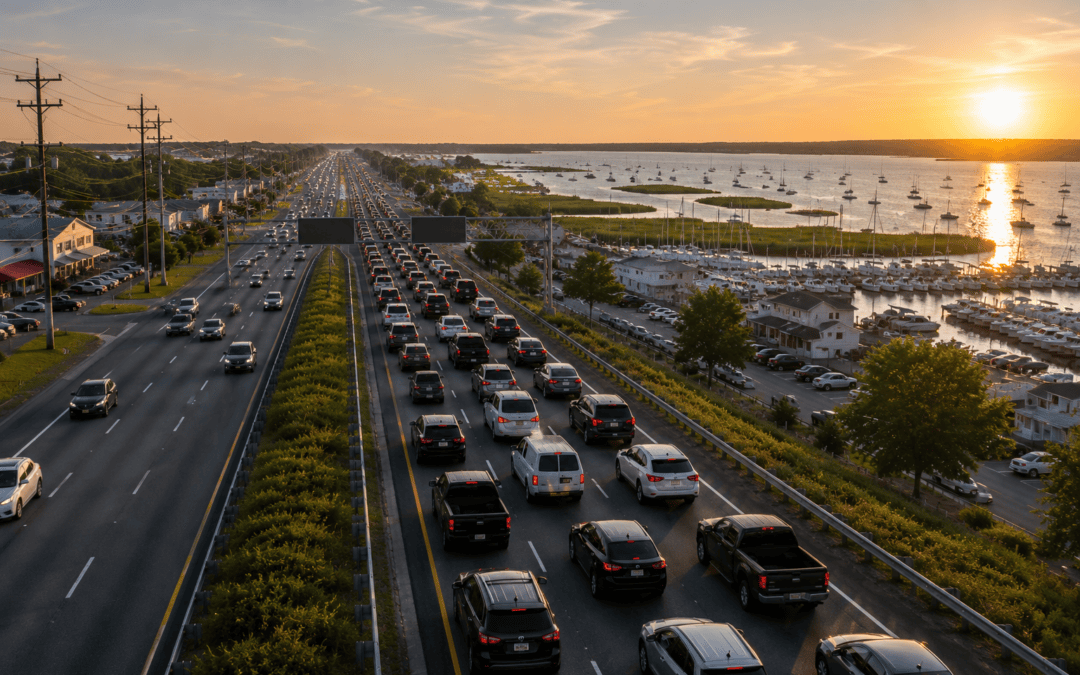
Memorial Day weekend changes how Long Island moves. Beach traffic fills the parkways, boat ramps stay busy from dawn, and roads that carry a predictable commute nine months of the year fill with drivers who do not know them. From the Long Island Expressway and Sunrise Highway to the Southern State and Northern State Parkways, summer travel brings a noticeable increase in congestion. The crash numbers follow. So do the boating accident numbers.
If you were hurt this summer on a Long Island road or on the water, that seasonal pattern is not an abstraction. It shapes how the accident happened, and it often shapes what evidence still exists a week later. Visitors return home, witnesses become harder to locate, and surveillance footage or other evidence may be lost if it is not preserved quickly. Here is what state and federal data show, and what matters most in the days after an injury.
Why Summer Car Accidents Increase on Long Island
The seasonal shape of crash data is consistent from year to year. The National Safety Council reports that motor vehicle deaths run lowest from January through April. They stay elevated from May through November, and July and August rank among the worst months of the year.
The reason is less dramatic than it sounds. Mileage climbs in summer. More trips, more miles, and more people on the road mean greater exposure to crashes. The Safety Council also notes that the death rate per mile driven peaks in September, not at midsummer. That points to something useful. Summer driving is not necessarily more reckless—it is simply much more congested. Heavy traffic also increases opportunities for distracted driving, sudden braking, and unsafe lane changes. Navigation apps, unfamiliar routes, and increased stop-and-go traffic can turn a momentary glance away from the road into a serious collision.
One group does face a sharper seasonal jump. AAA’s review of federal crash data found that 13,135 people died in crashes involving a teen driver between 2019 and 2023. More than 30 percent of those deaths fell in the roughly 100 days between Memorial Day and Labor Day. Summer averages eight such deaths per day nationally, compared with seven during the rest of the year. School is out. Newer drivers spend more hours behind the wheel, more of those hours after dark, and more of them with friends in the car.
Long Island Is Still a Crowded Suburb
This is the part that gets lost in general summer driving advice. Heading east does not mean leaving traffic behind. It means driving through dense residential communities, past beach parking, village centers, farm stands, and popular destinations such as Jones Beach, Fire Island, and the Hamptons, on arterial roads that were never designed for the volume they carry in July and August.
The numbers support that. A New York State Comptroller analysis of federal fatality data put Long Island’s traffic death rate at 8.4 per 100,000 residents in 2022. New York City’s was 2.9. The statewide figure was 6.0. Suffolk recorded 164 deaths that year and Nassau 81, the two highest county totals in New York. Suffolk also led every county in the state in four separate categories: fatal crashes involving a distracted driver, fatal crashes involving speeding, occupants killed without restraints or helmets, and deaths involving a driver over the legal limit.
Those figures are a few years old now, and county totals move from year to year. The underlying pattern has not. Long Island pairs suburban density with high-speed arterial roads, and that combination produces a fatality rate well above the state average before a single summer visitor arrives. The same congestion that increases rear-end and intersection crashes also creates particular risks for motorcyclists. During the summer months, increased traffic, unfamiliar drivers, and frequent lane changes make it easier for motorists to overlook motorcycles before turning or merging.
The Water Gets Just as Crowded
Summer congestion is not limited to pavement. Long Island’s waterways become just as congested as its highways during the busiest months of the year. New York’s 2025 Recreational Boating Report shows a seasonal curve steeper than anything on the roads. Across 2005 through 2025, July alone accounted for 1,277 reported boating accidents and 109 deaths statewide. January accounted for just 20 accidents. February accounted for 11.
Weekends carry most of the burden. Over that same period, Saturdays and Sundays together produced more reported accidents than all five weekdays combined.
Long Island water appears throughout the report. Its 2025 accident table lists Nassau and Suffolk waterways repeatedly, with Great South Bay, Sag Harbor Bay, Shinnecock Bay, and Shelter Island Sound each appearing more than once.
The report identifies collisions as the most common accident type and states directly that waterways are increasingly crowded, requiring operators to adjust how they run their boats. It also found that intoxication was the primary contributing factor in 84 boating deaths between 2005 and 2025, roughly 21 percent of the total. Notably, a substantial share of reported incidents involves vessels docking, undocking, or tied to a mooring. Many boating injuries do not happen at speed, which surprises many people unfamiliar with recreational boating.
One requirement is now fully in effect. The 2025 season completed the phase-in of Brianna’s Law, so every operator of a motorized vessel in New York must now hold a boating safety certificate regardless of age. New York State Parks lists the approved classroom and online courses.
Fact Patterns That Recur Every Summer
- Rear-end and merge collisions on the Long Island Expressway, Sunrise Highway, and the parkways during Friday and Sunday peaks
- Left-turn crashes on Montauk Highway and Route 25 involving drivers unfamiliar with the intersection
- Motorcycle collisions where another driver turned across the rider’s path or changed lanes into it
- Pedestrians and cyclists struck near beaches, downtowns, and village centers after evening events
- Personal watercraft and powerboat collisions in congested bays, channels, and inlets
- Injuries that occur while boarding, docking, or moving around a vessel tied to a dock or mooring
- Crashes and boating incidents involving alcohol, which state data identifies as a leading contributing factor in fatal accidents on both roads and water
What to Do After a Summer Crash or Boating Accident
Get medical attention first, even if you feel able to wait. Injuries that seem manageable at the scene often present differently a day or two later. An unexplained gap between the accident and treatment becomes an argument against you later.
After that, a few steps matter more in summer than they do the rest of the year. Acting quickly can make a significant difference in protecting a potential claim. During the summer, vacationers often leave Long Island within days, surveillance footage may be overwritten, and damaged vehicles or vessels are repaired before they can be thoroughly documented. Taking steps to preserve evidence early can make it easier to establish what happened and who was responsible.
- Report it. New York requires qualifying boating accidents to be reported to State Parks, and the reporting windows are short. Crashes involving injury should be reported to police at the scene.
- Photograph everything before it changes. Vehicle or vessel positions, damage, road and water conditions, signage, weather, and visible injuries.
- Identify witnesses immediately. Summer witnesses are often visitors who leave Long Island within days and become very difficult to locate afterward.
- Preserve the vehicle or vessel in its post-accident condition where you can, and keep repair estimates, marina records, and tow receipts.
- Write down what you remember while the details are fresh, including the sequence of events and anything the other operator said.
- Speak with an attorney promptly. Time-sensitive deadlines can apply, and which ones apply depends on the specific facts of your case.
One further note for anyone injured in a motor vehicle accident this year. New York’s rules governing motor vehicle injury claims changed in 2026, and we address those changes in a separate discussion of the 2026 auto insurance reform. How fault is documented at the scene is worth taking seriously.
In both motor vehicle and boating accident cases, the strongest evidence is often gathered within the first few days after an incident. Early legal guidance can help preserve important records, identify witnesses before they leave the area, and obtain accident reports or other evidence while it is still available.
Speak With a New York Car and Boating Accident Lawyer
If you were injured in a crash or a boating accident on Long Island this summer, the facts that decide these cases are often the ones that disappear first. The attorneys at the Law Offices of Rudolph F.X. Migliore, P.C. can evaluate your potential claim at no cost. The firm represents injured people throughout Nassau and Suffolk counties in car, truck, and motorcycle accident claims. We can help you understand what records, reports, and evidence your case will need.
Call our Commack office at 631-543-3663 for a free, confidential case evaluation, or use our online contact form. There is no fee unless we recover compensation for you.
This article is for general informational purposes and is not legal advice, and it reflects information available as of its publication date; laws, regulations, and case developments change over time. Each case depends on its specific facts, and any filing deadline that may apply should be determined by an attorney. No outcome can be guaranteed in any litigation.