
TikTok Lawsuits
TikTok Lawsuits
Practice Areas


TikTok Lawsuit: Teen Harm and Dangerous Challenge Claims

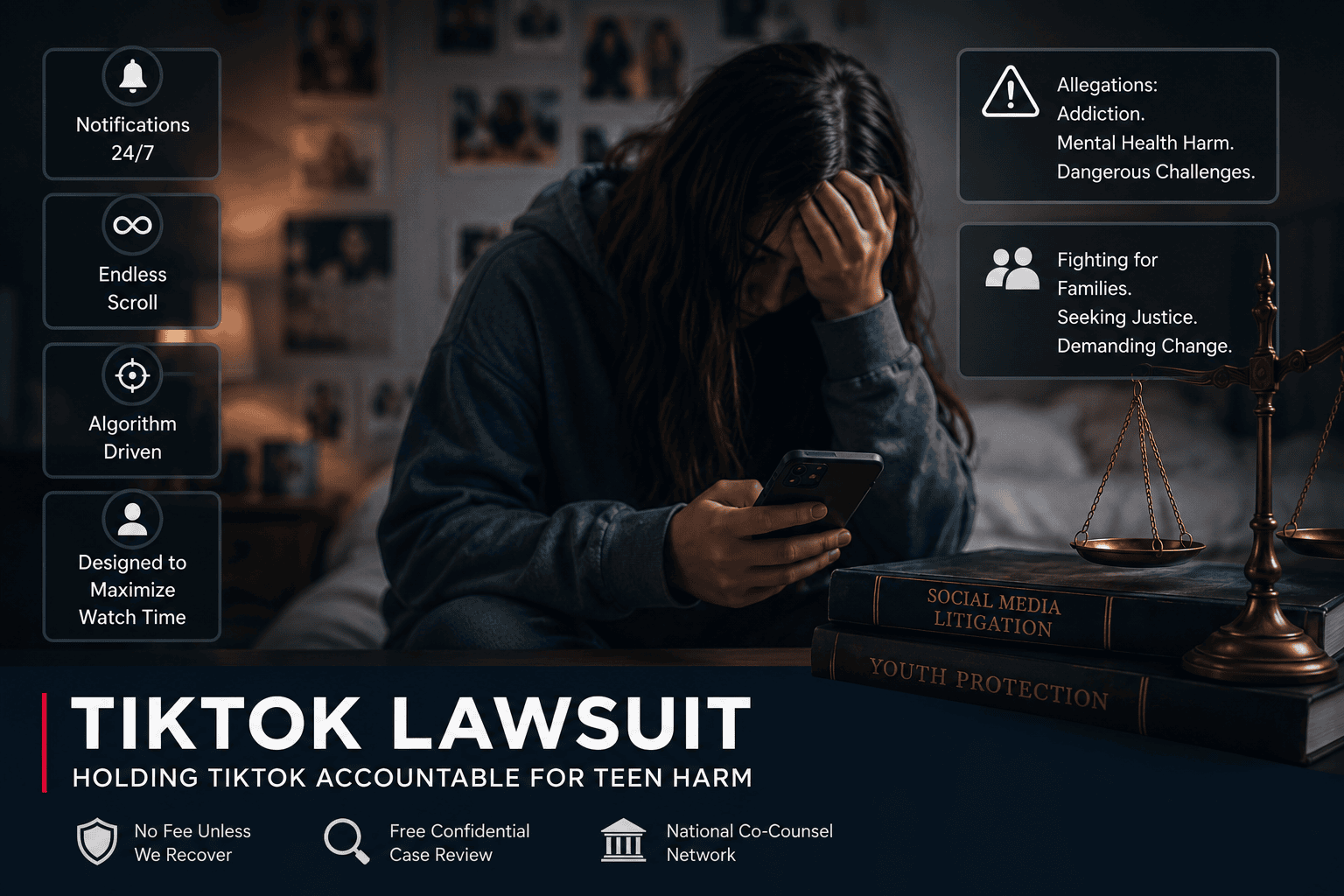
TikTok’s “For You” feed is the most effective attention machine ever aimed at teenagers — and it is now the subject of two kinds of lawsuits. Families allege the app was engineered to addict adolescents, and that the same algorithm pushed dangerous viral “challenges” into children’s feeds with deadly results. TikTok has already settled the first two test cases to reach the courthouse. If TikTok use that began in childhood was followed by a serious mental-health injury, the Law Offices of Rudolph F.X. Migliore, P.C. — working with a nationally recognized co-counsel network — can review your family’s situation at no cost. This page is part of our broader coverage of the social media addiction lawsuits.
Two Kinds of TikTok Claims
Unlike traditional social networks that primarily display content from friends or accounts a user chooses to follow, TikTok’s For You feed is driven largely by algorithmic recommendations. Plaintiffs allege that the recommendation system rapidly learns a child’s interests and continually serves increasingly engaging content, encouraging prolonged use and, in some cases, exposing young users to harmful material.
Addiction and mental-health claims sit in the coordinated federal proceeding, MDL 3047, alongside the cases against Instagram, Snapchat, and YouTube — roughly 2,664 cases as of June 2026, according to the JPML docket. The features named in the complaints are the ones parents already worry about: a recommendation algorithm built to maximize watch time, endless scroll, round-the-clock notifications, and beauty filters tied to body-image harm.
Dangerous-challenge claims arise from viral stunts the algorithm spread to children — most infamously the “Blackout Challenge,” which encouraged kids to choke themselves. A ten-year-old girl named Nylah Anderson died after the challenge appeared on her For You page, and in 2024 a federal appeals court ruled her family’s case could proceed: because TikTok’s algorithm chose to recommend that video to her, the court held, Section 230 — the law that shields platforms from liability for what users post — does not protect TikTok for its own recommendations. That decision was not a finding of liability, but it removed the industry’s primary defense for algorithm-driven harm. Following the Anderson decision, certain algorithmic recommendation claims involving dangerous challenges have also become part of the broader coordinated federal litigation, although the MDL remains primarily focused on youth mental-health and addiction claims.
TikTok Settled the First Test Cases
When the first bellwether trial approached in Los Angeles, TikTok settled the plaintiff’s claims confidentially in January 2026, shortly before jury selection, with no admission of liability — the $6 million verdict that jury later returned was against Meta and Google only. In the first federal test case, brought by a Kentucky school district, TikTok was among several defendants that participated in the reported $27 million confidential resolution in the spring of 2026. Those settlements ended those two cases and nothing more: there is no global settlement, and each pending case continues to be evaluated on its own facts and evidence. Snap settled the same two test cases — see our Snapchat lawsuit page for that side of the litigation.
New York Is Leading the Case Against TikTok
New York is not on the sidelines of this one. In October 2024, New York Attorney General Letitia James co-led a bipartisan coalition of 14 attorneys general in suing TikTok for misleading the public about its safety — the New York complaint points to dangerous challenges that have injured and killed young New Yorkers, including a teenager who died subway surfing after watching videos of the stunt. In 2025, a New York court denied TikTok’s motion to dismiss the Attorney General’s case, allowing it to move forward. Those government actions seek penalties and design changes, not compensation for individual families — but they are building the public record that private cases draw on. Our firm represents Long Island and New York families in the national litigation through our co-counsel network.
You May Qualify If…
- The social media use began before age 18
- The person harmed is currently 25 or younger
- The use was followed by a serious mental-health injury, including an eating disorder, self-harm, body dysmorphia, or suicidal thoughts or attempts — and we also review cases for families who lost a child to suicide after heavy social media use
Additional case-specific factors apply to every matter. Meeting these criteria does not guarantee a case — the only way to know where you stand is a free, confidential review.
Every case is different. These lawsuits generally allege that addictive platform design contributed to serious mental health injuries by encouraging prolonged, repetitive, and compulsive use. Establishing causation requires reviewing the individual’s history, medical records, social media usage, and other case-specific evidence.
Frequently Asked Questions: TikTok Claims
Is there a TikTok settlement I can join?
No. TikTok settled the first bellwether plaintiff’s claims confidentially in January 2026 and participated in the Kentucky school district’s reported $27 million resolution in 2026 — but those settlements resolved those two cases only, neither was an admission of liability, and no court has found TikTok liable. The individual claims continue, evaluated and filed one at a time.
What did the Anderson ruling change?
In 2024, a federal appeals court ruled that Section 230 — the law that usually shields platforms from liability for what users post — does not protect TikTok when the claim is about TikTok’s own algorithm recommending harmful content to a child. That ruling let a family’s case over a deadly viral challenge go forward, and it is one reason these lawsuits have momentum. It was not a finding of liability; it means the claims get decided on their merits.
What would we need to show?
In general, we investigate cases where the TikTok use began before age 18, the person harmed is currently 25 or younger, and the use was followed by a serious mental-health injury such as an eating disorder, self-harm, body dysmorphia, or suicidal thoughts or attempts. Families often do not yet have complete medical or counseling records when they first contact us. Those records can frequently be obtained during the investigation if appropriate. Additional case-specific factors apply, and meeting these criteria does not guarantee a case.
What does it cost?
Nothing up front. These cases are handled on a contingency fee — no fee unless we recover compensation for you — and the review is free and confidential. Call 631-543-3663.
Talk With Us About a TikTok Claim
If TikTok use that began before 18 was followed by a serious mental-health injury, the Law Offices of Rudolph F.X. Migliore, P.C. can evaluate a potential claim at no cost, from Long Island, for families throughout New York. Call 631-543-3663 or use the contact form below. There is no fee unless we recover compensation for you.
This page is for general information and is not legal advice. The lawsuits described here contain allegations that have not been fully resolved in court, settlements are not admissions of liability, and the March 2026 verdict is subject to post-trial motions and appeal. Each case depends on its own facts, and no outcome can be guaranteed.
Privacy & Communications Policy


Contact us for a