

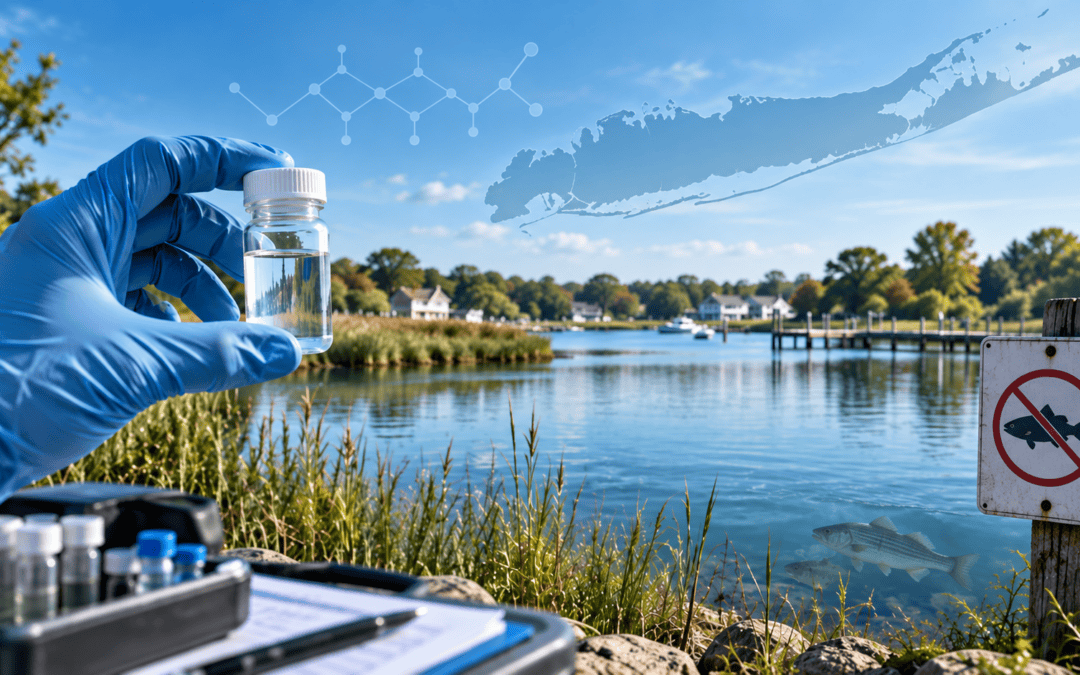
A new analysis of surface-water tests from 2022 through 2024 found PFAS in Long Island waters at all 13 monitoring sites in its data, Newsday reported on October 14. PFAS, short for per- and polyfluoroalkyl substances, are long-lasting industrial chemicals often called “forever chemicals.” The Long Island sites include Lake Ronkonkoma, Connetquot Brook, and the Carmans River. According to Newsday, two sites on the Peconic River had the highest PFAS concentrations among the Long Island locations.
If you live near one of these waters, fish in them, or use a private well, you may have questions about your health and your legal options. A reading in a stream is not the same as contaminated tap water, and on its own it is not a claim.
What the Analysis Found
The nonprofit Environment America Research & Policy Center published its national report on PFAS in lakes and streams on October 13. Its authors compiled existing test results, mostly from the public Water Quality Portal, and left out drinking water, groundwater, and wastewater samples.
Nationally, at least one PFAS compound turned up at 1,329 of the 1,602 locations in the data, about 83 percent. On Long Island, the sites Newsday identified also include tributaries of Manhasset Bay, Willetts Creek, and Beaverdam Creek.
The report notes its limits. It covers only waters someone chose to test, and many are never tested for PFAS. Because PFAS compounds vary in how harmful they are, detection counts also do not measure health risk.
What This Means for Drinking Water and Fish
Nassau and Suffolk get their drinking water from a sole-source aquifer, not from the lakes and streams in this report. Still, the two are linked. The U.S. Geological Survey notes that streams, lakes, and wetlands get most of their fresh water from groundwater. But a detection in a creek does not show that any particular public supply or private well is contaminated. Answering that takes testing of the water itself and an investigation of likely sources.
The Navy sampled fish at Swan Pond in Calverton in 2024. After it released results showing elevated levels of PFOS, Suffolk County banned fishing at the pond in March 2026. The State Health Department, which identifies PFOS as the PFAS most often found in fish, also advises anglers on which local catches to limit or avoid. In 2025, it added PFOS-based advice for the Carlls River in Suffolk County.
When PFAS Exposure Can Support an Injury Claim
Evaluating a PFAS injury claim starts with three questions: whether you were exposed, whether you have a diagnosed illness, and whether evidence connects the two. Attorneys also look at where the contamination came from and who may be legally responsible. A detection in a nearby creek does not answer those questions.
In the national firefighting foam litigation, the court’s August 2025 case management order lists the six injuries that plaintiffs’ leadership is pursuing:
- Kidney cancer
- Testicular cancer
- Thyroid cancer
- Liver cancer
- Thyroid disease, including hypothyroidism
- Ulcerative colitis
That list reflects the claims being pursued. It is not a court finding that PFAS causes any of these conditions. The federal Agency for Toxic Substances and Disease Registry includes kidney and testicular cancer among the health effects that studies have associated with PFOA. An association in studies does not prove that PFAS caused any one person’s illness. The manufacturers dispute that their products cause these diseases.
These cases are built on records: where you lived and when, your water source and any test results, and medical records confirming the diagnosis and its date. Our earlier article on PFAS drinking water claims in New York covers those records.
Where the Litigation Stands
Federal firefighting foam cases, including personal injury claims, are consolidated in MDL 2873 before Judge Richard M. Gergel in the U.S. District Court for the District of South Carolina. A multidistrict litigation, or MDL, gathers similar federal cases before one judge for shared pretrial work, while each plaintiff keeps an individual case. The Judicial Panel on Multidistrict Litigation’s October 1, 2026 report lists 15,264 pending actions in the MDL as a whole.
The August 2025 order also took the first personal injury bellwether trial off the calendar. That test trial had been set for October 2025. Under an August 31, 2026 case management order, briefing on challenges to expert testimony about whether PFAS can cause thyroid cancer and liver cancer runs through January 22, 2027. That question, called general causation, comes before whether PFAS caused any one person’s illness.
Which proceeding a claim belongs in, and which state’s law applies, are evaluated at intake. Our Long Island PFAS page has more background.
What to Do Now
- If you are on public water, check your water supplier’s annual water quality report for its PFAS test results.
- If you rely on a private well in Suffolk County, look into a state pilot program that offers free PFAS testing for eligible wells. It also helps pay for treatment or a hookup to public water. Check whether it is still accepting applications.
- Before eating fish you catch, check the State Health Department’s current fish advisories for that water, and respect posted bans like the one at Swan Pond.
- If you have been diagnosed with one of the conditions above, gather your records and speak with an attorney promptly. Any filing deadline that may apply depends on the specific facts and should be determined by an attorney.
What Comes Next
The Legislature has passed S3207B, a bill to tighten New York’s public drinking water limits for PFOA and PFOS. It would cut them from 10 parts per trillion to no more than 4 and set limits for three other PFAS. As of mid-October 2026, it had not been signed into law. A drinking water limit, on its own, does not decide whether someone has an injury claim. Both the bill and the litigation may change, so confirm their current status.
Speak With a New York PFAS Lawyer
If you drank Long Island water that may have contained PFAS and were later diagnosed with one of these conditions, we can review your history and records. The attorneys at the Law Offices of Rudolph F.X. Migliore, P.C. can evaluate your potential claim at no cost. We work with co-counsel networks active in the PFAS litigation and can help you understand whether your case fits the litigation and what records will be needed to move forward.
Please note that at this time the firm is able to accept PFAS cases only in limited circumstances. A case evaluation will tell you whether yours is among them.
Call our Commack office at 631-543-3663 for a free, confidential case evaluation, or use our online contact form. There is no fee unless we recover compensation for you.
This article is for general informational purposes and is not legal advice, and it reflects information available as of its publication date; laws, regulations, and case developments change over time. Each case depends on its specific facts, and any filing deadline that may apply should be determined by an attorney. The manufacturers named in the firefighting foam litigation deny wrongdoing and dispute the claims against them. No outcome can be guaranteed in any litigation.