

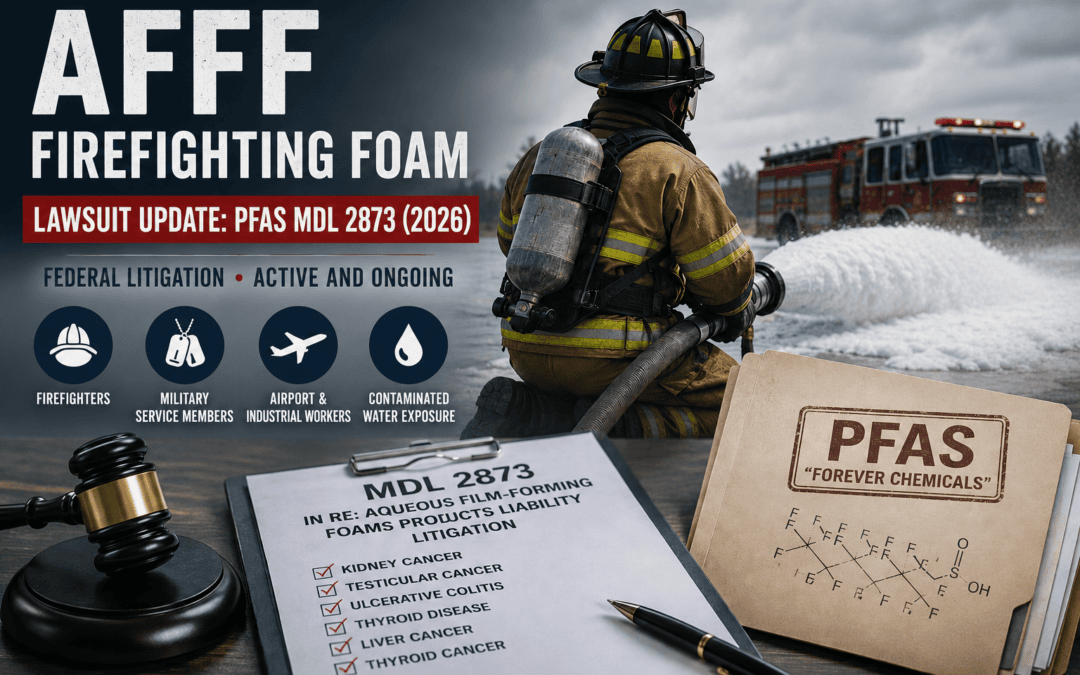
The litigation over aqueous film-forming foam, the PFAS-based firefighting foam commonly called AFFF, has grown into a major federal mass tort. As of the Judicial Panel on Multidistrict Litigation’s June 2026 docket report, thousands of actions are pending in the consolidated proceeding, making it one of the largest active multidistrict litigations in the country.
If you spent years around firefighting foam, or lived near an airport, military base, or fire-training site where it was used, and you were later diagnosed with cancer or another serious illness, this is the litigation that concerns you. Here is where it stands in 2026 and what the current phase means for people who were exposed.
Where the AFFF Litigation Stands in 2026
The federal cases are consolidated as MDL 2873, formally titled In re: Aqueous Film-Forming Foams Products Liability Litigation, in the U.S. District Court for the District of South Carolina before Judge Richard M. Gergel. Multidistrict litigation gathers similar cases before one judge for shared pretrial work. It does not merge them into a single claim. Each plaintiff keeps an individual case.
The proceeding is unusually large, and much of the past year has gone to managing that size. In August 2025, the court vacated a personal-injury bellwether trial that had been set for that October, after learning that many new cases had been filed without the documentation the court requires. A bellwether is a test trial, chosen to show both sides how juries may respond to representative facts before the parties negotiate a broader resolution.
Water-System Settlements Are Not Personal-Injury Compensation
Many people have read about very large PFAS settlements and assume the litigation is essentially over. It is not, and the distinction matters. In 2023, 3M agreed to pay public water suppliers a sum valued at up to $10.3 billion, and DuPont, Chemours, and Corteva agreed to pay about $1.185 billion, to resolve claims brought by drinking-water systems for the cost of testing and filtering PFAS.
Those settlements pay water utilities to clean up water. They do not compensate a person who developed cancer. Individual injury claims, which make up most of MDL 2873, are a separate track, and that track has not produced any global settlement. The people bringing those cases include firefighters, military service members, airport and industrial workers, and residents who drank contaminated water.
The Current Phase: Vetting the Docket
Rather than a trial calendar, the near-term story is procedural. The court has focused on confirming that the cases on its docket are properly supported:
- Its August 2025 order set specific proof requirements for injury claims, including evidence of a qualifying diagnosis, documentation of PFAS exposure, and detailed fact sheets.
- In February 2026, the court established a process for identifying and dismissing cases that fail to meet those requirements.
- No new personal-injury bellwether trial date has been set publicly. When one is, it will signal the next major phase of the litigation.
This is an active proceeding, and its schedule can change quickly. Anyone following it should confirm the current status rather than rely on a single report.
The Science and the Injuries at Issue
PFAS, per- and polyfluoroalkyl substances, are called “forever chemicals” because they resist breaking down in the environment and in the body. In 2023, a working group convened by the International Agency for Research on Cancer classified PFOA, one of the two most-studied PFAS, as carcinogenic to humans, its highest hazard category, and classified PFOS as possibly carcinogenic.
An important caveat comes from IARC itself. That classification identifies whether a substance can cause cancer, not how much risk any one person faces, which depends on how much a person was exposed and for how long. It is a statement about hazard, not a verdict in any particular case.
Recent EPA regulations establishing national drinking water standards for certain PFAS compounds have increased public attention to PFAS contamination, although those regulations do not determine liability in personal injury litigation.
In the litigation, the plaintiffs’ leadership is pursuing a defined set of conditions the court has grouped for pretrial work: kidney cancer, testicular cancer, ulcerative colitis, thyroid disease, liver cancer, and thyroid cancer. The individual cases are product-liability claims against the companies that made and sold the foam. The manufacturers deny liability. AFFF was produced for decades to federal specifications for military and aviation firefighting, and the companies dispute both general causation and their responsibility for how it was used.
Who May Have a Claim
Eligibility is fact-specific, but the people most often affected share a pattern of exposure followed by a serious diagnosis. Common situations include:
- Firefighters and fire instructors who used AFFF in response or training.
- Military service members stationed where AFFF was used, particularly at airfields and fire-training areas.
- Airport, refinery, and industrial workers who handled the foam.
- Residents who relied on drinking water contaminated by nearby AFFF use and later developed one of the illnesses at issue.
Key elements typically include documented exposure, a qualifying diagnosis, and records that establish the connection over time. Because these illnesses often surface years after exposure, locating older documentation is a common practical hurdle. Useful records often include military records, employment records, training records, environmental reports, residential history, and medical records documenting the diagnosis. An attorney experienced with this litigation can help reconstruct that history.
The Long Island and New York Connection
PFAS contamination from firefighting foam is not a distant problem for New Yorkers. On Long Island, the State declared the Air National Guard Base at Francis S. Gabreski Airport in Westhampton Beach a State Superfund site in 2016, after PFOS from firefighting foam was found in area groundwater. Regulators named the U.S. Department of Defense as the party responsible for the contamination, and Suffolk County found PFAS in private wells near the base.
The Law Offices of Rudolph F.X. Migliore, P.C. represents New York residents, including Long Island residents affected by PFAS, in national mass-tort proceedings like this one, working through a nationwide co-counsel network. How any individual New Yorker’s case fits the federal litigation, including which state’s law may apply, is a question evaluated at intake on the specific facts. The consolidated proceeding itself runs under federal procedure and the MDL court’s orders, not by assumption.
What Comes Next
The near-term signals to watch are procedural: how the court resolves the pending non-compliance dismissals, and when it sets a new personal-injury bellwether trial. A bellwether verdict, whenever it comes, is what tends to move settlement discussions on the individual-injury track. Until then, the record being built now, on exposure, diagnosis, and causation, is what any future resolution will be measured against.
For people who were exposed to AFFF and later became ill, the practical point is straightforward. The litigation is active, the evidence in each case matters, and any deadline that might apply depends on the specific facts and should be reviewed by an attorney without delay.
Speak With a New York AFFF and PFAS Lawyer
If you or a loved one developed cancer or another serious illness after exposure to AFFF firefighting foam, we can review what happened and whether a claim may be available. The attorneys at the Law Offices of Rudolph F.X. Migliore, P.C. can evaluate your potential claim at no cost. We work with co-counsel networks active in the AFFF litigation and can help you understand whether your case fits the federal proceeding and what records will be needed to move forward.
Call our Commack office at 631-543-3663 for a free, confidential case evaluation, or use our online contact form. There is no fee unless we recover compensation for you.
This article is for general informational purposes and is not legal advice, and it reflects information available as of its publication date; laws, regulations, and case developments change over time. Each case depends on its specific facts, and any filing deadline that may apply should be determined by an attorney. The manufacturers deny wrongdoing, and no determination of liability has been made by any court. No outcome can be guaranteed in any litigation.