

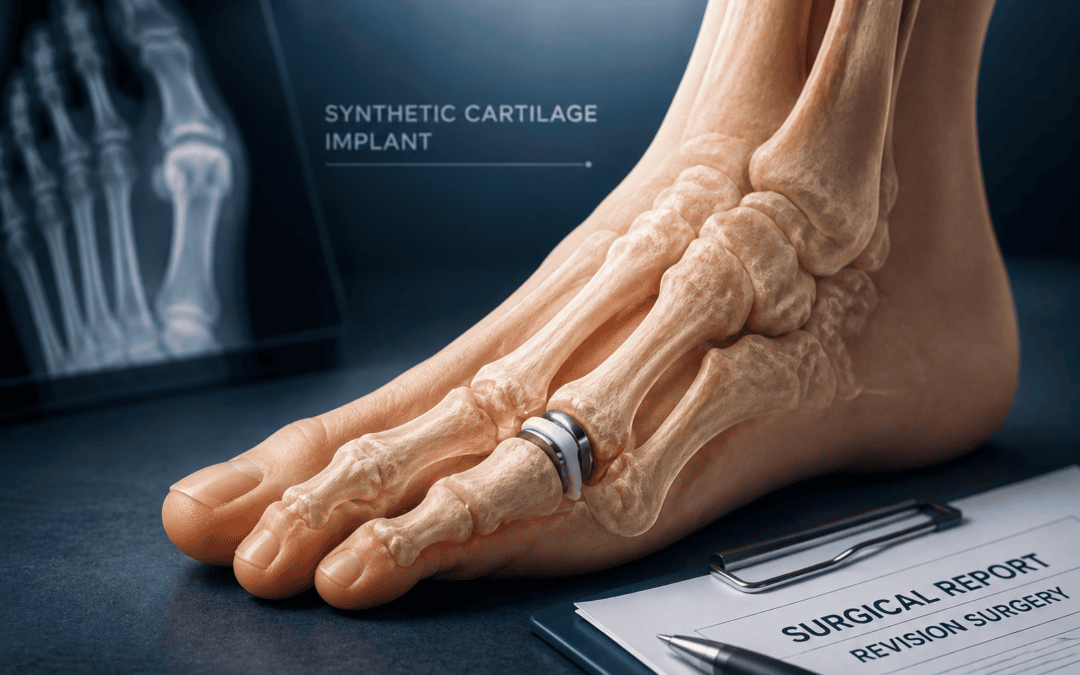
Hundreds of patients across the country have reported failed Cartiva toe implants, many requiring painful revision surgery. A 2024 analysis of FDA adverse event reports counted 236 submissions involving the device through mid-2023, including 102 revision operations. The federal litigation is still in its earliest stages, however, and the first major hearing is now scheduled for August 26.
On that date, lawyers for both sides will appear before Chief Judge Kristine G. Baker in Little Rock for the first organizational hearing in MDL 3172. Almost nothing has been decided yet.
Did you receive a Cartiva Synthetic Cartilage Implant and later need it removed, or the joint fused? Below is what the court has ordered, what the August hearing sets in motion, and what the FDA’s approval file shows. For how the litigation was consolidated, see our earlier overview of the Cartiva MDL.
What the August 26 Hearing Will Decide
Judge Baker set the hearing in a letter order entered June 22, 2026. It begins at 1:30 p.m. Central time, and counsel may appear by video. Magistrate Judge Patricia S. Harris is assigned to the litigation alongside Judge Baker.
The real work lands a week earlier. By August 19, both sides must submit proposals for how counsel will be organized, addressing lead counsel, liaison counsel, a plaintiffs’ steering committee, and the fee structure. Both sides must also summarize where the cases stand: pending motions, a discovery plan, existing protective orders. Defendants were asked whether they will move to dismiss on jurisdiction or service grounds, among other threshold issues.
These appointments matter more than the name suggests. The lawyers the court selects direct common discovery and take the corporate depositions. Individual claimants keep their own cases, but the record those lawyers build is what every case gets measured against.
Why Only 21 Cases Are Pending
The Judicial Panel on Multidistrict Litigation’s July 1, 2026 docket report lists 21 actions pending in MDL 3172. That is modest for a mass tort, and there is a procedural reason. Judge Baker entered an order upon transfer on February 18, 2026 that stayed all outstanding discovery and barred new discovery until the initial conference. The litigation has been largely holding still since, waiting for the meeting now scheduled for August.
The docket kept absorbing filings. The Panel entered six conditional transfer orders between February and June 2026. Counts are republished monthly, so today’s number is likely higher.
The manufacturer opposed all of this. The Panel’s February 5, 2026 transfer order records that Cartiva, Inc. argued its own settlement process made an MDL unnecessary. The Panel disagreed, noting the parties vigorously disputed how much discovery had actually been shared.
What the FDA’s Approval File Shows
The Cartiva SCI reached the market through premarket approval P150017, granted July 1, 2016. That is the FDA’s most demanding device pathway, and the agency’s summary of safety and effectiveness is public. It repays reading.
The pivotal trial, called MOTION, enrolled 202 subjects at 12 sites in the United Kingdom and Canada. No United States sites took part. It was a non-inferiority study, meaning it asked whether the implant performed no worse than fusion by more than a set margin. It was not designed to show the implant was better. The FDA then required a revised primary endpoint, pushing assessment from 12 months to 24. On that revised measure, 79.8 percent of implant patients and 78.7 percent of fusion patients counted as successes.
Two other figures matter. Through 24 months, 17 of the 152 implant patients in the safety group underwent a secondary surgical intervention, or 11.2 percent. Fourteen, 9.2 percent, had the implant removed. Separately, 26 percent lost range of motion over two years, cutting against the motion-preserving rationale for the device.
The most striking passage is a sensitivity analysis the FDA ran itself. The composite success measure included a radiographic component defined differently for each arm. The agency recalculated success with that component stripped out. The lower bound came back at negative 15.6 percent, against a requirement that it stay above negative 15 percent. On that calculation, non-inferiority did not hold. The FDA still approved the device on the pre-specified endpoint, and called the clinical relevance of the radiographic criteria uncertain. Both statements sit in the same document.
What the 2024 Recall Did and Did Not Say
The manufacturer initiated a recall on October 31, 2024, and the FDA posted the classified record that December as number Z-0598-2025. The Class II recall covered all lots of all four sizes distributed from July 2016 through October 2024, the device’s entire commercial life in this country.
The company’s stated reason was that implanted patients faced higher than expected rates of revision, removal, subsidence, displacement, pain, nerve damage, and fragmentation. Subsidence means the implant sinks down into the surrounding bone. The FDA recorded its own determination of the cause in two words: device design. Agency policy allows that determination to be revised until a recall is terminated, and this one remains open.
What the recall did not do matters just as much. It did not tell patients to have implants removed. It told surgeons to keep monitoring patients for pain that returns or intensifies, trouble walking, stiffness, swelling, or weakness at the joint, and told facilities to return unused inventory. Anyone living with a Cartiva implant should raise it with their surgeon rather than assume removal is needed.
The Preemption Fight Ahead
Because the device carries premarket approval, the defense is expected to argue federal preemption, the position that federal device law displaces state-law claims. In Riegel v. Medtronic, Inc., 552 U.S. 312 (2008), the Supreme Court held that federal law preempts state requirements “different from, or in addition to” the federal requirements attached to an approved device.
That holding is not the end of the road. The same opinion confirms that a state may still provide a damages remedy for claims premised on a violation of the FDA’s own regulations. In that situation the state duty runs parallel to the federal requirement rather than adding to it. Lawyers call these parallel claims, and pleading them properly is the central drafting problem in these cases. Note that the Court never resolved the parallel-claim argument in Riegel, because the plaintiffs there had not raised it below.
How the doctrine applies to any individual Cartiva case is unresolved, and no court has ruled on it in this MDL. Which state’s law governs a particular claim is a separate question, decided case by case, and it does not default to the state where a plaintiff lives.
Who May Have a Claim
Eligibility turns on the facts, but the claims being filed tend to share several features:
- A Cartiva implant placed in the first metatarsophalangeal joint at the base of the big toe, between July 2016 and October 2024.
- Pain, stiffness, swelling, or lost motion that persisted or worsened instead of resolving.
- Imaging showing subsidence, displacement, or fragmentation of the implant.
- A revision operation to remove or replace the device.
- Conversion to fusion, which permanently eliminates joint motion and is often the surgery the implant was chosen to avoid.
- Bone loss, nerve damage, or ongoing inflammation attributed to the device.
The records that matter most are the operative report identifying the implant and its size, imaging from before and after symptoms began, and documentation of any later surgery.
The New York Connection
The FDA’s recall record lists New York among the states where the device was distributed. Orthopedic and podiatric practices across Long Island and the state used it during those years. Some patients are only now linking a stubborn toe problem to a recall they never heard about.
The Law Offices of Rudolph F.X. Migliore, P.C. represents New York residents in national device proceedings through a nationwide co-counsel network, and reviews product liability claims for Long Island clients at no cost. How an individual case interacts with New York law is something we evaluate at intake rather than assume. Filing deadlines are not uniform, and the one that applies to a particular claim should be determined by an attorney.
What Comes Next
Expect the usual sequence. The court appoints leadership, replaces the discovery stay with a real schedule, and sets deadlines for common discovery and early motions. Preemption briefing is the likely first battleground. Bellwether trials, the representative cases tried first to gauge how juries respond, come later. No bellwether date has been set.
This is an active proceeding and its posture can change quickly, so confirm the current status before relying on any single update, including this one. For patients, the point is that the record driving every future settlement is about to be built.
Speak With a New York Cartiva Implant Lawyer
Revision surgery, implant removal, or conversion to fusion are often the strongest indicators that a patient should have his or her case reviewed. If you or a loved one went through any of those after a Cartiva toe implant, the attorneys at the Law Offices of Rudolph F.X. Migliore, P.C. can evaluate your potential claim at no cost. We work with co-counsel networks active in MDL 3172 and can help you understand whether your case fits the federal litigation and what records will be needed to move forward.
Call our Commack office at 631-543-3663 for a free, confidential case evaluation, or use our online contact form. There is no fee unless we recover compensation for you.
This article is for general informational purposes and is not legal advice, and it reflects information available as of its publication date; laws, regulations, and case developments change over time. Each case depends on its specific facts, and any filing deadline that may apply should be determined by an attorney. Cartiva, Inc. denies wrongdoing, and no determination of liability has been made by any court. No outcome can be guaranteed in any litigation.